Laura arrived deeply distressed. She was about to be admitted to hospital with severe ulcerative colitis, a chronic inflammatory bowel disease (IBD), and felt she had tried everything. Having heard a little about family constellations, she was willing to explore her illness from a systemic perspective, hoping this work might support her healing.
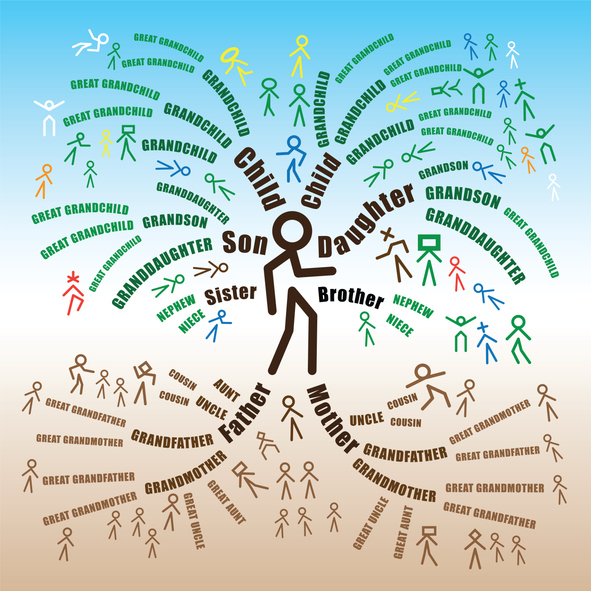
I often wonder what will unfold in a session, and this one was no different. As we mapped Laura’s family history through a genogram, themes of war, migration and the early deaths of partners, parents and children emerged. These are some of the experiences we explore in constellation work, and they featured prominently across her Polish family’s history.
We approached her symptoms with a central question: Whose story might the symptom be telling?
Laura’s grandfather had been killed when a bomb struck the house, and her paternal great-grandmother had been killed by Nazi soldiers. Her family’s history was marked by the trauma of war, including children taking on the responsibility of raising other children.
Particularly significant was her father’s horrific experience of the war: whom he had managed to save from his family, and how they had escaped Nazi firing squads. He experienced illness throughout his life.
Following these threads, we explored the family’s experiences through a constellation. Stories of suffering and trauma emerged across three generations of Laura’s ancestors.
When working systemically, we ask “Who?”, “When?” and “How?” to elicit the facts, rather than focusing primarily on “Why?”
During the constellation, a connection emerged between Laura’s experience of her symptoms and the story of her paternal great-grandfather. As she deeply acknowledged what had happened, she described a sense of energy, experienced as grey smoke, leaving her body.
Over the following weeks, Laura reported that her symptoms eased, with some disappearing. This was her reported experience following the session, rather than evidence that the constellation had treated her ulcerative colitis.
For Laura, the constellation offered a way to acknowledge her family’s stories of suffering and injustice, and to recognise those who belonged within the family system. The work centred on bringing these experiences into view and exploring a renewed sense of belonging, balance physically and systemically and support.
Are you the symptom bearer of an ancestors story that was too big for them to hold?
By the time Sophie arrived for her session, she had already broken up with her partner, reconciled with him, and broken up with him again. None of this had happened out loud.
It had started the night before, when Ben left his cereal bowl on the kitchen bench. Not in the dishwasher. On the bench, approximately 40 centimetres from the dishwasher.
“I’ve told him a hundred times,” Sophie said. “He just doesn’t care about me.”
I asked whether she would explore that last sentence using Byron Katie’s inquiry process, The Work. Sophie agreed, although she reserved the right to remain annoyed about the bowl.
When the brain goes to war
For Sophie, the bowl was no longer just a bowl. It had become evidence in a case against Ben. Her mind began collecting supporting exhibits: the socks he left on the floor, the towel on the bed, the mysterious inability to replace an empty toilet roll.
This is a relatable example of negativity bias—our tendency to give negative information more attention and weight than positive information. In that moment, Sophie could recall the towel instantly. Ben making her tea when she was ill last week? That detail did not enter into the equation at the moment of the bowl!
The amygdala is one part of the brain involved in noticing emotionally significant information, including possible threats. If Sophie interprets the bowl on the bench as “Ben doesn’t care about me,” the meaning she gives it may contribute to a stress response: tight shoulders, a racing mind and an urge to defend herself. That does not mean a cereal bowl is a threat, or that we can know what Sophie’s amygdala did without measuring her brain activity. It means an ordinary moment can feel much bigger as the belief creates the fear of being not cared for, or that she does not matter. Issues that may have not been metabolised from childhood now playing out in the form of a bowl being left on a bench.
By breakfast, Sophie’s brain had assembled a battle plan. Ben, meanwhile, thought they were having breakfast.
The thought under the argument
I invited Sophie to write down one thought: “Ben doesn’t care about me.”
“Is it true?” she asked.
“Yes,” Sophie replied. “Exhibit A: the bowl.”
“Can you absolutely know it’s true?”
Sophie paused. Ben had made her tea when she was ill. He had driven across town to collect her from a delayed flight. “I know he left the bowl out,” she said. “I don’t actually know what that says about how much he cares.”
“How do you react when you believe the thought?”
“I become a detective. Every sock is new evidence. Then I make sarcastic comments, and when he asks what’s wrong, I say ‘Nothing’ in a voice that means prepare your defence.”
“Who would you be in that moment without the thought?”
“Still a person who wants the bowl in the dishwasher,” Sophie said. “But I could ask for that without conducting a domestic crime scene investigation.”
These are the four questions at the heart of The Work. They had not changed what Ben did. They had helped Sophie notice the difference between an observable event—he left a bowl on the bench—and her painful conclusion about what it meant.
Another way to see it
Next came the turnarounds. Sophie tried alternative versions of her thought, looking for honest examples of where it is truer rather than forcing herself to think positive.
Turnaround
What Sophie noticed
“Ben does care about me.”
He had shown up when she was sick and stranded at the airport. The bowl did not erase those moments.
“I don’t care about Ben.”
When Sophie was hurt, she sometimes saw Ben as a collection of annoying habits rather than asking what was going on with him.
“I don’t care about me.”
Sophie had been swallowing her frustration for weeks instead of clearly saying what she needed.
“So I’ve been expecting him to read my mind,” Sophie said, “when he apparently can’t even read the dishwasher.”
The turnarounds didn’t prove Ben was right, or that Sophie should accept cleaning up after Ben. They gave her more than one possible interpretation to work with.
Neuroscience offers a useful parallel here. Research on cognitive reappraisal—reconsidering what a situation means—shows that interpretation can influence emotional responding. It does not prove that this specific inquiry switched off Sophie’s amygdala or that The Work has one established brain mechanism. But it helps explain why moving from “He doesn’t care” to “I need to talk to him about the dishes” might change the conversation.
The conversation at home
That evening, Sophie did not open with “You never care about me.” She said, “I’m getting frustrated about the dishes. Can we work out who’s doing what?”
Ben listened. Then he admitted he had assumed putting dishes near the dishwasher counted as progress. Sophie informed him that, in her household classification system, it did not.
They talked about the dishes and about the resentment Sophie had been carrying. Ben did not instantly become a man who could detect an abandoned teaspoon from three rooms away. But Sophie no longer had to argue as though a cereal bowl had delivered a final verdict on their relationship.
Inquiry had not asked her to ignore the problem. It had helped her put down the imaginary sword, the emotional charge and assumptions, long enough to say what she actually needed.
If you are not using power-over tactics—such as yelling, justifying, withdrawing, or relying on your usual communication defaults—how do you negotiate in a way that gets your needs met?
Compromise often has a cost: one person gives something up, and someone may leave the conversation feeling unheard or disappointed. Likewise, pushing for a solution the other person does not agree with can create conflict, resentment, and frustration.
A needs-based approach to negotiation is different. Rather than deciding who is right or whose solution wins, you work together to find a solution that supports both people’s needs. This is what creates a genuine win-win outcome.
You can use this process with children, partners, parents, siblings, friends, or work colleagues—any relationship where you want to stay connected while working through a difference.
The Six Steps
1. Identify Each Person’s Needs
Start by identifying what each person truly needs. Be careful not to confuse a solution with a need.
For example, “I need you to come with me” is not a need—it is a proposed solution. The need underneath it may be connection, support, reassurance, belonging, rest, autonomy, or appreciation.
Sometimes we do not immediately know what our real needs are. In that case, ask yourself:
“If I got this solution, what would that then give me?”
The answer usually points to the underlying need. You can also use a needs list to help put words to what is important for each person.
2. Brainstorm Solutions
Once both people’s needs are clear, brainstorm as many possible solutions as you can.
Let the ideas flow. Be creative, silly, practical, simple, or ambitious—at this stage, the goal is to generate options, not judge them.
Do not analyse, criticise, or dismiss ideas while brainstorming. Evaluating too soon can create conflict and shut down the creative process.
3. Evaluate Solutions Against the Needs
Now look at each possible solution together and ask:
“Does this meet both of our needs?”
The purpose is not to compromise by having each person lose something important. Instead, negotiate until you find an option that genuinely supports both people.
For example, going out for dinner might meet one person’s need for connection, but it may not meet the other person’s need for support, space, security, or rest. Keep exploring until you find an option that meets both sets of needs.
4. Choose a Solution
Collaboratively choose the solution that best meets both people’s needs.
A win-win solution needs to tick both boxes. If it only works for one person, return to the brainstorming stage and keep negotiating. The aim is mutuality—not one person getting their way while the other person simply agrees to keep the peace.
5. Implement the Solution
Be clear about how the agreement will work in practice.
Decide:
What will happen
Who will do what
When it will happen
What support, resources, or preparation are needed
A clear plan helps prevent misunderstandings and makes it more likely that both people will follow through.
6. Check the Results
Choose a time and place to come back together and review how the solution worked.
Ask:
Did this meet both of our needs?
What worked well?
What did not work?
What would we do differently next time?
This step is important because even a well-intended solution may need adjusting once you try it. Reviewing the outcome keeps the process flexible, fair, and collaborative.
Holding the Tension
Secure, healthy relationships require us to hold a certain amount of tension without moving into war, withdrawal, blame, or power struggles. Staying collaborative when there is disagreement is an art, and it takes communication skills, patience, and practice.
You may be able to work through all six steps in one conversation. At other times, it may be wiser to pause—especially if someone is tired, overwhelmed, or emotionally activated—and return later with fresh ideas.
The key is to remain flexible while making a shared commitment to resolve the issue with fairness and mutuality. A win-win outcome is not about getting everything you want. It is about finding a solution where both people feel considered, respected, and supported.
When I first started learning effective communication skills, I developed little equations in my head to help me construct a self-disclosure message, an active listening response, or a confrontative I-message.
These little equations became a way of training my brain. With practice, the steps became familiar, and eventually the communication skills became more natural and automatic.
I often work with clients and couples who have great difficulty recognising their feelings and needs, let alone finding the words to express them. This is where a few simple, repeatable steps can be incredibly helpful. We can literally train the brain to develop new neural pathways and create new habits for how we communicate.
And it starts with self-empathy.
Self-Empathy
Self-empathy means turning your attention inward and becoming curious about what is happening for you.
You might ask yourself:
What am I feeling?
What is happening for me right now?
What need is underneath this reaction?
What am I wanting, valuing or longing for?
Before we can communicate effectively with another person, we need some capacity to understand ourselves.
Many people try to communicate their experience without having a vocabulary for what they are actually feeling or needing. Instead, they jump straight to explaining what the other person is doing wrong.
“You never listen to me.” “You don’t care.” “You’re so selfish.”
These statements may express distress, but they don’t necessarily reveal what is happening inside us or the need that is trying to be met, or how the other’s behaviour is effecting us. Instead they create conflict as they are ‘YOU’ messages and the brain perceives this as a threat.
Self-empathy gives us the opportunity to pause and discover what is underneath the reaction.
What am I feeling? What do I need?
Once we have some clarity, we can begin to share that experience with another person.
Here is a feelings and needs listto support you to begin to familiarise yourself to expand from mad, sad and glad.
Self-Disclosure
Self-disclosure is the process of giving another person a glimpse into our internal world.
Using effectiveness training, self-disclosure is about communicating your own experience rather than making the other person the problem.
A powerful shift that builds relationships.
Have you ever noticed how interested and connected your partner becomes when they get a genuine glimpse of what is happening inside you — particularly when they are not being blamed for it? There is something deeply connecting about being invited into another person’s inner world.
A Simple Self-Disclosure Equation
One little equation I use to help people practise this is:
I + feel + fact
For example:
“I get really excited when I am able to express myself clearly.”
Or:
“I am saddened when I’m not able to communicate what I need.”
The formula is simply a training tool. It helps you remember to speak from your own experience.
Be Careful With the Word “Feel”
An important part of learning self-disclosure is noticing whether the word feel is actually followed by a feeling.
For example:
“I feel that you are not listening to me.”
The word feel appears in the sentence, but there is no feeling being highlighted as well as “you are not listening to me” is actually an interpretation or judgement about the other person’s behaviour not the facts.
A fact is something you can see, hear or otherwise directly experience.
For example:
“When I we are talking and you looked at your phone, I am disappointed as I was eager to spend time with you”
Now we have:
Fact: Talking together, and looking at phone Feeling: disappointed and eager
The focus stays with my experience, rather than becoming an accusation about your intention. That way we don’t force the other into conflict and we still get to express our disappointment.
This small distinction can make a significant difference to how a message is received.
Train Your Brain
Communication is made of micro-skills that practiced over time changes the way we express ourself.
Try this simple exercise:
Send Three Self-Disclosure Messages Per Day
Share three genuine self-disclosure messages with someone each day.
They don’t have to be deep or complicated.
You might share:
“I’m really enjoying this coffee this morning with you.”
“I’m a little nervous about today’s presentation.”
“I’m really grateful that we’re having this time together.”
“I’m excited about what we’re planning together .”
“I’m tired and I need some quiet time this evening.”
If remembering is difficult, attach the practice to something you already do.
You could share your self-disclosure messages:
over your morning coffee
when you greet someone
when you send a text
when you arrive home
before going to bed
The more you practise noticing your internal experience and putting it into words, the easier it becomes.
You are not simply learning a communication technique.
You are training your brain to create a new way of relating.
And with practice, those little formulas can become something much more valuable than formulas.
They become capacity.
Capacity to know yourself. Capacity to express yourself. And ultimately, capacity to create deeper connection in your relationships.
The Game Changer in Relationships: Curiosity Over Justification
There is a moment in almost every relationship conflict when the conversation reaches a fork in the road. It may begin with a forgotten phone call, an impatient tone of voice, an unanswered text message or the familiar words:
“You never listen to me.”
In that moment, there are two very different paths available.
One path leads towards justification. The other leads towards curiosity.
The difference between them can determine whether two people move into conflict drift or create connection.
Most of us don’t consciously choose justification. It simply arises as a default as our brains are wired for war. As we read the signs, the sound of the voice, the frown, the eye roll and walking away our primitive parts of our brain engage and we go to war. Before we have even realised what is happening we start to defend ourself
“That’s not true.”
“I do listen.”
“You don’t understand how stressful my day was.”
“What about all the times I’ve been there for you?”
Suddenly, the conversation is no longer about understanding one another or taking care of the space in the middle, that couple bubble, that connection.
It becomes a courtroom. Each person presents evidence. Each person defends their intentions. Each person quietly hopes the jury will declare them innocent.
Yet relationships rarely heal because someone finally proves they were right. And if you are fighting about memory ie who said what when, they you are both right and both wrong!
We heal when someone becomes curious enough to ask,
“Tell me more.”
Why We Justify
Justification is rarely selfish or uncaring. Most often, it is psychobiological.
When we perceive we are being criticised, misunderstood or blamed, our sympathetic nervous system (fight and flight system) automatically prepares us for danger. Long before we consciously choose our response, our body has already begun responding as though we are under threat.
Our heart beats faster. Our breathing becomes shallow. Our muscles tighten. Stress hormones such as adrenaline and noradrenaline prepare us to defend ourselves. Then the cortisol clicks in! Our reptilian brains evolve over thousands of years, a response that helped our ancestors survive physical danger, engages!
Today, however, the greatest threats are often emotional.
A threat to our identity.
A threat to our belonging.
A threat to feeling loved.
A threat to believing we are enough.
So when a partner says,
“I felt hurt when you didn’t call,”
our nervous system may hear,
“You’re failing me.”
“You’re a terrible partner.”
“You’re letting me down.”
Without even realising it, we stop listening for understanding and begin listening for danger. The brain shifts from connection to protection.
The emotional centres responsible for detecting threat become highly active, while the prefrontal cortex—the part of the brain responsible for empathy, curiosity, perspective-taking and thoughtful decision-making—becomes less available.
We are no longer asking, “What is happening for my partner?”
Instead, our nervous system asks, “How do I protect myself?”
And so we justify.
“I was busy.”
“I told you I had meetings.”
“You know how stressful work has been.”
Everything we say may be true, but truth spoken from a defensive nervous system does not meet a need to be heard, understood, acknowledgement, for connection, for safety and care.
When Two Nervous Systems Go to War
The moment one person needs to be heard and isn’t, their nervous system becomes activated too.
They speak louder.
You defend yourself harder.
They become more emotional.
You become more certain.
They pursue.
You withdraw.
Or perhaps both of you fight.
The original issue quietly disappears beneath two nervous systems desperately trying to protect themselves as well as get their needs met!
What looked like an argument about dishes, money or a phone call has become something much deeper.
It has become two human beings asking silent questions.
Do I matter?
Am I safe with you?
Do you understand me?
Do I matter to you?
Will you reject me?
Will you choose me?
Genuine intimacy requires enough safety for people to remain present with themselves and with one another, even when difficult emotions arise. When the nervous system becomes overwhelmed, curiosity naturally narrows and self-protection takes over.
This is why telling your partner to “calm down” rarely works! Yet shifting gears to hear the need that is trying to be met does.
An activated nervous system cannot simply be reasoned into feeling safe. Sometimes healing begins by slowing everything down.
Breathing.
Softening our voice
Sitting down and facing each other
Waving the flag of friendliness before you go offline
Taking a break and coming back when regulated to discuss the issues
The Hidden Longing Beneath Every Argument
One of the greatest shifts whether we are a couple, a parent, a daughter, sibling, colleague or employer, we can make is learning to hear what sits beneath the words. Listening for feelings and needs trying to be met.
When someone says,
“You never help me,”
perhaps what they are really saying is, “I feel lonely and need support”
“You don’t care about me.”
may actually mean, “I want to matter to you”
“You’re always on your phone.”
may really be saying, “I miss connecting with you”
Justification responds to the accusation.
Curiosity listens for the longing, the feelings and needs.
This is why curiosity is so powerful as it maintains connection whilst taking care of the space in the middle and not default to pro-self.
Rather than asking, “How do I prove I’m right?” it quietly wonders,
“What pain am I hearing underneath these words? What need is trying to be met?”
Shifting Gears: From Defending to Listening
Curiosity is more than asking good questions. It is learning to shift gears.
When we become defensive, we naturally listen for mistakes in our partner’s story. We prepare our response before they have even finished speaking.
We interrupt.
We explain.
We defend.
Curiosity asks us to able to hold the tension enough to temporarily put our own story aside, for a moment, and become deeply interested in the others.
This is where active and empathetic listening become transformational.
Active listening means being present and feeding back the feelings and facts that are trying to be expressed.
Empathetic listening goes even deeper.
It listens for feelings and unmet needs embedded in the longing beneath the behaviour and words.
Instead of responding with defensiveness when you hear:
“You never listen,”
we begin by responding by saying
“It sounds like you are eager to be heard around this?”
Or
“Is it that you are anxious as you would really like to connect?”
Notice that none of these statements require agreement and there is no “I” as you have left the message with the other.
It is simply communicating to gain understanding first.
It is only after we have gained understanding of the other and we are on the right track not consumed by assumptions, do we gently offer our own experience in the form of feelings and needs.
“Thank you for sharing that. Would you be willing to hear my experience about the situation?”
This is one of the beautiful paradoxes of relationships.
The fastest way to be understood is often to help the other person feel understood first.
Your feelings matter equally. But two activated nervous systems cannot truly listen at the same time. Someone has to shift gears first.
Curiosity Is Not Surrender
Many people worry that curiosity means admitting they were wrong.
It doesn’t.
Curiosity is not agreement.
It is not accepting blame for something you didn’t do.
It is not tolerating abuse.
Curiosity simply says,
“Your experience matters enough for me to understand it before asking you to understand mine.”
There is enormous strength in that. Because when people feel emotionally safe, they naturally become more curious about us in return.
From Winning to Repair
Healthy relationships are not built because we avoid conflict. They are built because we learn to repair after conflict., and quickly.
Repair begins when we recognise that intention and impact are often different. You may never have intended to hurt someone. Yet they may still have experienced hurt.
One simple sentence can change the entire direction of a conversation.
“It looks like that really upset you?”
That is not admitting malicious intent. It is acknowledging another person’s reality. And sometimes that is all the nervous system needs to begin relaxing.
Protecting the Relationship Instead of Protecting Yourself
The next time conflict begins, notice the moment you feel the urge to defend yourself.
Pause. Get curious!
Take one slow breath.
Notice your body.
Then ask yourself one question.
“Am I trying to protect my position, or am I trying to protect this relationship?”
Transformation does not emerge through pressure or persuasion, it emerges with tiny habits and grows from presence and emotional safety. It grows when curiosity becomes stronger than justification.
Because perhaps the greatest act of love is not having the perfect answer. It is having the courage to remain curious.
To listen before explaining.
To understand before correcting.
To reflect before reacting.
To protect the relationship before protecting your ego.
So before saying,
“But…”
pause. Ask,
“Help me understand what is going on for you.”
Listen for the feelings.
Listen for the needs.
Listen for the longing beneath the words and behaviour.
Then, once the other knows they have been heard, gently share your own heart.
Because love is rarely strengthened by proving who was right. It is strengthened when two people feel safe enough to stop defending themselves and begin discovering one another again.
That is the quiet power of curiosity.
And sometimes, it is the doorway that leads two people home to each other, to security, mutuality and respect.
Judy walked into my room clinging tightly to the arm of her partner. A tall, elegant woman of 69, she appeared frightened, vague and uncertain. She sat down without letting go of him. I noticed immediately her dependence on him and his apparent impatience with that dependence. Each time he shifted away, she reached for him again. Judy had brought him for support, but it quickly became clear that his presence was not helping her feel safe.
Judy had been referred to me by a local wellness clinic. More than ten years earlier, she had been prescribed Cymbalta (duloxetine), a serotonin-norepinephrine reuptake inhibitor (SNRI), by her psychiatrist.
SNRIs are based on the “monoamine hypothesis” of depression. They work by blocking the serotonin transporter (SERT) and norepinephrine transporter (NET), theoretically increasing signalling in parts of the brain involved in mood, attention and pain regulation. However, despite decades of use, the precise mechanisms of antidepressants and antipsychotics remain poorly understood.
Judy had originally been prescribed 30 mg of Cymbalta. Several years earlier she had attempted to discontinue the medication and had successfully reduced to 5 mg. However, she dropped from 5 mg to zero too quickly and experienced severe withdrawal symptoms. Feeling “awful,” she returned to her doctor, who reinstated Cymbalta at 60 mg before later reducing it to 30 mg and adding Lexapro (escitalopram), an SSRI, to “assist” the withdrawal process.
Her pharmacist raised concerns about serotonin syndrome, which caused Judy considerable anxiety. Serotonin syndrome is a potentially serious reaction caused by excessive serotonin activity, usually when multiple serotonergic medications are combined. Ironically, while stopping psychiatric medication too abruptly can be dangerous, adding medications can also create complications.
This uncertainty led Judy to compulsively research her symptoms online using ChatGPT and other sources, which only intensified her fear.
What Judy was actually experiencing was a combination of rapid withdrawal from psychotropic medication, multiple interacting prescriptions, escalating anxiety, poor sleep and eventually akathisia.
Akathisia is a movement disorder characterised by an intense inner restlessness and an overwhelming urge to move. Although not life-threatening, it can be profoundly distressing and may contribute to agitation, despair and suicidal thinking.
Neuroadaptation and Withdrawal
Over the years Judy’s brain had adapted to the medications she was taking. This process, known as neuroadaptation, involves changes in receptor sensitivity and neurotransmitter regulation. When medications are withdrawn too quickly, the nervous system can become destabilised.
Judy had experienced this before. In her twenties, after treatment for anorexia, she had abruptly stopped antidepressants and experienced withdrawal symptoms. Years later, when she attempted to stop Cymbalta rapidly under medical guidance, she again experienced severe withdrawal.
Unfortunately, as often happens, her psychiatrist interpreted the withdrawal symptoms as a relapse of depression or anxiety and reinstated the medication at a higher dose.
Withdrawal vs Relapse
Distinguishing withdrawal from relapse is critical.
Withdrawal symptoms typically begin within days of reducing or stopping medication. They may include:
dizziness
nausea
insomnia
“brain zaps” or electric shock sensations
anxiety and agitation
akathisia
intrusive or violent thoughts
Withdrawal symptoms often improve if the medication is reinstated to the last stable dose.
Relapse, on the other hand, usually develops gradually over weeks or months and mirrors the original emotional presentation prior to medication. It does not reliably improve with rapid dose increases.
Repeated cycles of withdrawal and reinstatement can also contribute to what is known as kindling.
Kindling
Kindling refers to a phenomenon in which repeated cycles of substance use and withdrawal sensitise the nervous system, causing each withdrawal episode to become more severe.
Historically associated with alcohol and benzodiazepines, kindling is now increasingly recognised in psychotropic drug withdrawal. Over time the nervous system becomes more reactive, increasing sensitivity to future reductions and making withdrawal progressively harder to tolerate.
Polypharmacy and Nervous System Overload
By the time Judy came to see me, she was experiencing severe anxiety, cognitive impairment and insomnia.
Her psychiatrist had prescribed propranolol, a beta blocker often used to reduce physical symptoms of anxiety. When Judy reported ongoing insomnia, she was then prescribed olanzapine, an antipsychotic medication commonly used for sedation at low doses.
The olanzapine caused significant morning sedation, so dexamphetamine was added to counteract the grogginess.
At this point, multiple medications with opposing effects were interacting in her system simultaneously:
Cymbalta
Lexapro
propranolol
olanzapine
dexamphetamine
The result was increasing agitation, anxiety and nervous system dysregulation.
If I were to fully explain the pharmacological interactions between these drugs, it would require another article entirely. Suffice to say, it was clear why Judy’s nervous system was in such distress.
Judy’s History
Judy explained that in 2008 she had been working as a social worker in an adolescent mental health unit while raising four adopted children on her own, one of whom was autistic and required intensive care.
She had never married. Work became a way of escaping the overwhelming responsibilities at home.
She also described a childhood in which she had acted as her mother’s confidant and emotional support. Between the ages of 16 and her early twenties she had struggled with anorexia and had previously been prescribed antidepressants.
To manage the overwhelm in adulthood, Judy increasingly relied on red wine. Eventually she entered a detox program, where she met the psychiatrist who first prescribed Cymbalta.
Even before our work together began, Judy had already experienced one failed taper. Following standard pharmaceutical guidelines suggesting that withdrawal effects are mild and self-limiting, her psychiatrist reduced her rapidly from 60 mg to 30 mg.
This history was significant because it suggested a sensitised or “kindled” nervous system. I knew she would likely require a very gradual taper to minimise further harm.
Dependence vs Addiction
The terms dependence and addiction are often used interchangeably, but they describe different phenomena.
Dependence
Dependence is primarily physiological. The body adapts to the presence of a substance and begins to rely on it to function normally.
Characteristics of dependence include:
tolerance
withdrawal symptoms when stopping
neuroadaptation within the nervous system
A person can be dependent without being addicted. For example, someone prescribed opioid medication for severe pain may develop physical dependence without compulsive misuse.
Addiction
Addiction is behavioural and psychological. It involves compulsive use despite harmful consequences.
Characteristics of addiction include:
loss of control
compulsive cravings
continued use despite harm
psychological reliance to manage emotional pain
From an Internal Family Systems (IFS) perspective, addictive behaviours can be understood as protective “firefighter” parts attempting to numb distress or emotional overwhelm.
In Judy’s case, her primary issue was dependence rather than addiction. Her brain had adapted to long-term exposure to psychotropic medication.
The Brain’s Adaptation to Medication
With antidepressants and antipsychotics, the brain adapts to the constant presence of the drug.
The widely promoted “chemical imbalance” theory of depression has been increasingly challenged in recent years. Critics argue that the theory was oversimplified and heavily marketed by pharmaceutical companies.
The brain continually strives for homeostasis. In response to ongoing medication exposure, receptor sensitivity changes and neurotransmitter systems recalibrate.
Over time the nervous system becomes dependent on the presence of the medication.
This is why reducing psychiatric medication can become so difficult.
Hyperbolic Tapering
Judy wanted to discontinue her medication safely. Given her history, I believed she would need to taper hyperbolically.
Hyperbolic tapering involves making progressively smaller reductions as the dose becomes lower.
Rather than reducing linearly — for example by dropping 10 mg each time — reductions become increasingly gradual near the end of the taper.
For example:
40 mg → 20 mg
20 mg → 10 mg
10 mg → 5 mg
5 mg → 2.5 mg
Another common approach is reducing by approximately 10% of the previous dose and holding for periods of stabilisation between reductions.
Why Hyperbolic Tapering Matters
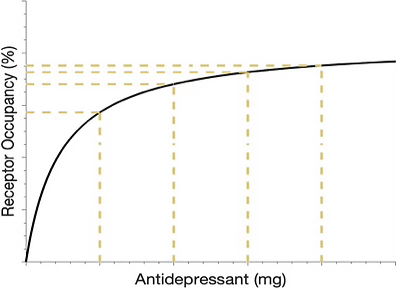
Research using receptor occupancy studies suggests that even low doses of antidepressants can occupy a very high percentage of brain receptors.
This means that small reductions at lower doses may have disproportionately large effects on the nervous system.
In practice, this is why dropping from 5 mg to zero can feel far more destabilising than reducing from 40 mg to 35 mg.
Psychiatrists and researchers such as Mark Horowitz and David Taylor discuss this extensively in The Maudsley Deprescribing Guidelines (2024). Anders Sørensen also explores these principles in Crossing Zero (2025).
The Emotional Dimension
Judy had spent much of her life moving away from painful emotions through work, wine and eventually medication.
This is profoundly human. Most of us seek relief from emotional pain.
However, tapering medication often means that long-suppressed emotions begin to surface again.
The therapeutic task is not simply medication reduction. It is helping the client build the capacity to tolerate and understand difficult emotional and bodily experiences.
Antidepressants can dampen emotional intensity, but they do not resolve the underlying life experiences, attachment wounds or unresolved trauma contributing to suffering.
Judy had never truly stopped to examine:
why she adopted four children while still very young and living at home
why she developed anorexia at sixteen
why she relied so heavily on work and caretaking
why she felt unable to tolerate stillness or emotional discomfort
Eventually, her attempts to numb overwhelm resulted in dependence on a complex medication regimen that caused significant iatrogenic harm.
A Kindled Nervous System
Judy’s tapering journey has been difficult.
Despite collaborative planning with her integrative doctor and myself, she struggled to follow the tapering schedule consistently. Feeling temporarily stable after an initial reduction, she reduced again too quickly.
Her nervous system reacted intensely.
Once a nervous system becomes highly sensitised or kindled, even minor changes — including supplements or seemingly benign medications — can trigger significant symptoms.
At that point, there is often no medication that can simply “fix” the problem. The work becomes learning how to gradually tolerate and regulate bodily sensations rather than constantly escaping them.
Judy also developed cognitive difficulties after multiple medication changes and additions.
Compounding matters further, her partner responded with frustration and criticism rather than emotional safety. From an attachment perspective, this lack of safety likely amplified her nervous system distress.
When overwhelmed, Judy repeatedly sought reassurance from her psychiatrist, whose primary response was further medication changes.
As the saying goes: when your only tool is a hammer, every problem begins to look like a nail.
The Role of Counselling
My primary focus with clients withdrawing from substances or psychotropic medications is resourcing.
In practical terms, this means helping them find even brief moments of safety, steadiness or calm within the body and mind.
Only when the nervous system has some degree of stability can deeper therapeutic work occur.
The goal is not merely to remove medication, but to help clients understand themselves more deeply rather than relying solely on substances or compulsive behaviours to manage distress.
Judy’s story is ongoing.
I hold hope for her because I have seen many people successfully taper from psychiatric medication when the process is gradual, collaborative and carefully supported.
I am one of them.
Her story highlights both the potential dangers of rapid psychotropic withdrawal and the importance of compassionate, informed care.
While her experience is extreme, it is not hopeless.
Every tapering journey is individual. With appropriate pacing, support and nervous system regulation, many people can successfully reduce or discontinue psychiatric medication.
References
Horowitz, M., & Taylor, D. (2024). The Maudsley Deprescribing Guidelines. Wiley Blackwell.
O’Brien, C. P., Volkow, N., & Li, T.-K. (2006). What’s in a word? Addiction versus dependence in DSM-V. American Journal of Psychiatry, 163(5), 764–765.
Sørensen, A. (2025). Crossing Zero. North and Vale.
In his book ‘Crossing Zero’ (2025), Anders Sorenson explains the receptor occupancy/dose relationship. For example, at only 20mg of Prozac – 86% of the brain’s receptors are occupied with serotonin from the drug. This means that the smaller the dose the greater the impact it has on the brain. Mark Horowitz and David Taylor also describe this in their comprehensive book ‘The Maudsley Deprescribing Guidelines’ (2024)
Whitaker, R. (2010). Anatomy of an Epidemic. Crown Publishing Group.
In his book “Anatomy of an Epidemic” (2010) Robert Whitaker summarises a World Health Organisation study (1998) showing that people diagnosed and treated with psychiatric medication for depression had worse outcomes than those not exposed to drugs.
Mark Horowitz interview on withdrawal, relapse and hyperbolic tapering:
In this interview Mark Horowitz discusses the difference between withdrawal and relapse, the effects of long-term antidepressant use and the role of clinicians and peer support in de prescribing and hyperbolic tapering.
Many years ago, whilst immersed in a silent retreat, in the bathroom of all places, I asked a question as my partner at the time walked past. The answer resulted in everything disappearing, and I experienced that we are consciousness itself. I saw how lifetimes don’t exist, there is no time and no space it is simply all now, I saw how we are never born and never die — only the body does. I have never been the same since.
The question was: How can I experience nothing when my enlightened teacher walks past, and nothing when my partner walks past?
My whole being replied, “Because you are nothing.”
I laughed so deeply and with pure joy that everything disappeared.
As a therapist, and for many gurus, how do you invite someone — including yourself when the ego takes over again — to that place of consciousness itself? Simple, sublime; there is nothing and everything at the same time. We can point to it, yet the moment the mind tries to grasp it, we are back in the mind.
How do we navigate feelings, thoughts, and pain bodies enough to quieten them so we can experience what never leaves us, what the mind continually overlooks in its searching?
I have discovered a technique that honours the premise that we are simply energy vibrating at a certain frequency. Scientists understand this in terms of viruses. Each virus vibrates at a certain frequency. Thoughts vibrate at a certain frequency, and we can observe their effect on water. Feelings vibrate at a certain frequency, and we experience their effects within our bodies.
They are like radio waves moving through us, but sometimes they get stuck and we begin vibrating at that frequency. This can be distressing because it is not the vibration of who we truly are. We call this suffering.
This is what we hold in.
Which also raises the question:
What do you hold out?
What delicious feelings, experiences, and sensations do you hold out?
If radio waves come and go, then the good stuff moves through you too.
Joel Young created a very quick technique called ‘Non-personal awareness’ that the mind will likely dismiss because of its simplicity. Yet it is a powerful process that meets the frequency of the thought, feeling, or pain body and disengages it from our being — in other words, sending it back where it came from, letting it move through you easefully.
Want to know how?
It is simple.
It involves six sentences.
Yep. Simple and elegant.
Here’s how
Firstly, grab a pen and paper, or journal or your phone so you can record your own dialogue.
Secondly, think of something that challenges you, constricts you, that you hold in. Just vomit it onto the page, or by speaking into your phone on record, and see what words, feelings, behaviours, thoughts, sounds, movements appear that are paramount, repeated. What is the fundamental thing. It does not have to make sense. You do not have to analyse it or figure it out, it is just energy stuck.
Take one of these which may have sounds and movements with it , without analysing it or trying to understand it or find parallels with your childhood, no interpretation needed, simply bring it into these sentences. For example, I may have deep feeling that people don’t care about me and a hand movement, and a sigh that goes with it.
Simply say (whilst adding the sigh and hand movement)
This people don’t care about me
This energy people don’t care about me
This pure energy people don’t care about me’
‘This pure energy people don’t care about me is not personal’ (3 times)
This pure energy people don’t care about me is not personal’
This pure energy people don’t care about me is not personal’
This pure energy people don’t care about me is not personal and I am willing to experience it’
Allow space for the sensations to arise, you can go as slow as you like. You may say the last sentence again.
Wait until you feel the clarity appear again and maybe a natural aliveness arises.
Now if energy is held in and it flows out, what is held out? What energy would you like to replace the energy that was held in that has now gone with? Maybe joy, ease, love, peace…find yours. Sometimes it arises naturally after the first part of the exercise. For example: ‘Connection’ arose after the first part of the exercise.
Take this feeling, sensation, whatever it is and bring it into the same sentences:
Simply say (adding your feeling in)
‘This connection’
‘This energy of connection’
‘This pure energy of connection’
‘This pure energy of connection is not personal’ (3 times)
This pure energy of connection is not personal and I am willing to experience it’
Simply notice what happens.
There is no need for analysing, interpretation, or fixing.
Simply experience the energy moving through you.
Some people have trauma leave their body, which can be overwhelming, I would simply allow the body to shake, cry and not to fear the movement of the energy. Simply repeat the sentences slowly.
30 Day Challenge
In this time in history, we are continually bombarded by radio waves — information, thoughts, pain bodies, feelings, and countless electronic frequencies that can interfere with our connection to our own true vibrational frequency.
Perhaps this is an opportunity.
An opportunity to allow these energies to move out and to let who you truly are move in.
So here is the challenge.
For 30 days, use your phone, journal, or a piece of paper and spend just a few minutes each day with this process.
Notice what you are holding in.
Everyday bring something that you hold in to the challenge by using the non-personal awareness exercise. Remember to invite yourself to experience what you hold out too after you have completed the first round, or a few rounds of what energy you hold in.
You may discover that the thoughts, feelings, stories, and sensations that once seemed so personal are simply energy moving through awareness.
Perhaps beneath the noise, beneath the stories, beneath the endless radio waves moving through the mind and body, there is a natural clarity, aliveness, peace, love, connection, or joy waiting to be experienced.
Not because you created it.
Not because you earned it.
But because it is already here.
The challenge is simple.
Thirty days.
A few minutes a day.
Six sentences.
And a willingness to experience what arises.
See what happens.
Let’s share the energy and add your comments below
The idea that we are all connected becomes especially clear when we look at families and communities as living systems rather than just collections of individuals. Within a family, each person’s experiences, beliefs, and emotional patterns ripple outward, subtly shaping the behaviour and wellbeing of others—sometimes across generations. A parent’s unresolved stress can influence a child’s sense of safety; a grandparent’s migration story can shape values around survival, sacrifice, or belonging.
These dynamics don’t exist in isolation, because families themselves are embedded within larger systems like culture, economy, and community networks. Communities, in turn, reinforce or challenge family patterns through shared norms, support structures, and collective experiences. When these systems are healthy and responsive, they can strengthen individuals by providing connection, identity, and resilience. When they are strained or fractured, they can perpetuate cycles of disadvantage or disconnection. In this way, individuals are both shaped by and contributors to the systems they belong to, constantly influencing and being influenced in an ongoing exchange.
In this way, individuals are both shaped by and contributors to the systems they belong to, constantly influencing and being influenced in an ongoing exchange—and this interconnectedness extends beyond human systems to include the natural environment, where our wellbeing is intimately tied to the health of the ecosystems we depend on, from the air we breathe to the land and resources that sustain life.
Family Constellations is a therapeutic approach that explores how hidden family dynamics, loyalties, and unresolved traumas shape our present-day behaviours, emotions, and relationships. Developed by Bert Hellinger, this method works on the premise that individuals are deeply connected to their family system across generations, often unconsciously carrying burdens that do not originate with them.
In my article “I Will Do It for You, Even If It Costs Me,”I highlight one of the central themes in Family Constellations work: the unconscious loyalty that leads individuals to take on pain, hardship, or limitation on behalf of others in their family system. This phenomenon often manifests as a silent inner contract—an inherited belief that says, “If you suffered, I will suffer too,” or “I will carry this so you don’t have to.” While rooted in love and belonging, these patterns can become deeply limiting.
The article illustrates how such loyalties may show up in everyday life. A person might struggle financially despite having opportunities, remain stuck in unhealthy relationships, or experience persistent feelings of guilt or anxiety without clear cause. Through the lens of Family Constellations, these struggles are not random; they may be expressions of unresolved family entanglements, where one family member unconsciously “represents” another’s fate.
A key insight from the article is the idea that love, in these cases, becomes distorted. Instead of supporting growth and vitality, it binds individuals to past suffering. Family Constellations seeks to gently uncover these dynamics, often through experiential exercises where participants represent family members and reveal hidden connections. This process allows individuals to see their situation from a broader systemic perspective.
Healing in this context does not come from rejecting one’s family, but from acknowledging what belongs to whom. Family Constellations emphasises that true resolution arises when individuals can honour their family members’ experiences without taking them on as their own. By doing so, they restore a natural order within the system—where each person carries their own fate, and love can flow more freely.
Ultimately, “I Will Do It for You, Even If It Costs Me”sheds light on the powerful, often invisible forces of familial love and loyalty. It reminds us that while these bonds are essential to our sense of belonging, they can also limit us when expressed unconsciously. Family Constellations offers a pathway to transform these inherited patterns, enabling individuals to live more fully in their own lives rather than in service of unresolved pasts.
SHORT VISUALISATION EXERCISE
Find a quiet place where you can sit comfortably and bring your attention inward. Gently acknowledge that you are not alone, even in this moment—you are connected to a wider system that stands behind you. In your mind’s eye, imagine your family system: your parents behind you, and behind them their parents, extending back through generations. There is no need to know their stories in detail—simply sense their presence. Notice that life has flowed through each of them to reach you. Take a moment to internally say, “I honour your lives, your struggles, and your gifts. What belongs to you, I leave with you. What has been given in love, I receive with gratitude.”
Now, expand your awareness to include the communities that have shaped you—friends, teachers, cultures, and places that have supported your growth. Acknowledge their influence and silently thank them for what they have contributed. Allow yourself to feel supported, as if you are standing within a field of connection rather than on your own.
Finally, bring in the natural world around you. Imagine the ground beneath your feet, steady and holding you, the air filling your lungs, and the wider living environment that sustains your body and energy each day. Sense that you are part of this larger web of life, not separate from it. As you breathe, allow a feeling of alignment to settle in your body—supported from behind, connected around you, and grounded below. From this place, gently return to your day, carrying a quiet sense of strength, belonging, and clarity.
In a culture that favours and celebrates couples, how do we celebrate Valentines Day amongst a generation who are pair bonding less, how do we celebrate passion, romance, aliveness, attraction and fundamentally love?
In a generation full of such uncertainty we can feed the fear or we can cultivate love and community. Therefore on Valentines Day let’s reclaim eros!
Eros, in Greek mythology, is the god of desire, erotic love, attraction and the primal force that draws use together either romantically or cosmically. Eros is the longing that drives humans toward beauty, creativity, and even spiritual transcendence.
Essentially Eros, is the quality of aliveness, vitality, and mystery that keeps us curious. In essence, Eros is the force of attraction itself—the spark that initiates connection, passion, and the creation of new life.
Esther Perel highlights that eros is not simply about sexual desire or sex but is the dynamic energy that emerges when we can experience both connection and individuality at the same time.
According to Perel it is:
The expression of our life energy. It is what makes us feel vibrant, creative, and turned on by life itself—not just by a partner.
Rooted in mystery and separateness. She often explains that while love seeks closeness and security, desire requires distance. Eros thrives in the space between two autonomous individuals.
Sustained by novelty and imagination. Predictability and routine can dull erotic energy; curiosity and surprise reignite it.
About wanting, not just having. Eros lives in anticipation, longing, and the tension between self and other.
Reclaiming Eros in Personal Life
How do we cultivate eros in our lives again?
To reclaim eros is to reclaim our own sense of vitality. It means becoming a person who is engaged, passionate, curious, and sensually awake to life. To open to life as though it was your lover. To move, breathe and appreciate life in such a way that the mundane comes alive in the most subtle moments.
I remember years ago I lawn mowed love hearts into the lawn, I painted a love story with my naked body on canvas, scattered rose petals, lit candles, cooked an aphrodisiac dish inspired by Isabel Allende’s book; ‘Aphrodite’…and so much more.
How you cultivate eros in your daily life is unique, through art, dance, food, meditation, nature-based activities, self-pleasuring, taking yourself out on a date, or celebrating with friends, however it is, it is your way. Here are some ideas for daily practices that may help celebrate eros beyond the bedroom:
1. Create Micro-Mysteries Resist over-sharing every thought and schedule. Allow space for individuality. Take a solo class. Change your routine. Let your partner (or the world) rediscover you.
2. Cultivate Self-Expansion Desire is fuelled by growth. Try something that makes you slightly nervous—a dance class, public speaking, creative writing. When we feel alive in our own skin, we become magnetic.
3. Practice Sensory Awareness Eros lives in the senses. Slow down while drinking your coffee. Notice textures, scents, music. Wear clothes that feel good on your body, not just practical.
4. Invite Playfulness Flirt. Tease. Laugh. Play disrupts routine and invites spontaneity, which is essential for erotic energy. Be curious about others in public.
5. Protect Time for Beauty Art, music, nature—these experiences awaken longing and inspiration. Beauty stirs eros because it reminds us that life is more than function.
6. Maintain Healthy Distance Spend intentional time apart. As Perel suggests, “Fire needs air.” When we step away from constant proximity, we make room for anticipation.
Eros as Personal Responsibility
Reclaiming eros is not about demanding more excitement from others. It is about becoming someone who is engaged with life. When we nurture our own passions, creativity, and mystery, we invite desire back into our relationships naturally, starting with the relationship with yourself.
Eros is less about what we do in private moments and more about how we inhabit our daily lives. It is the courage to remain curious. The willingness to open to life in new ways, celebrate the you are love and you have the freedom to pursue what makes us feel vibrantly alive.
In a culture that prizes efficiency and productivity, choosing eros is almost radical. It asks us to slow down, to savour, to risk a little uncertainty.
And perhaps that is the real invitation: not to chase the spark, but to become it!
As we watch the world rapidly changing I have been contemplating a question, one that I have been researching for about 40 years as a therapist. The question is:“How do we optimise the brain and body to deal with constant change and challenges effectively?” As a teacher in holistic counselling I draw on many modalities from:
Yet the one thing that protects us from our nervous systems going into overdrive and overwhelm and discombobulation is relationships, secure functioning relationships. We look after these relationships so they look after us. Secure functioning relationships can be co-created, we do not have to be secure to co-create a secure environment with others, just committed to make it happen, know the ingredients, and the steps and then follow the rules, including repair and fighting fair. So what are the ingredients to create secure functioning relationships:
A Shared vision and purpose– Why are you together? What can you do with each other, you can’t with anyone else (For intimate partners)
Fighting fair rules as well as how to repair – repairing quickly means things do not go into long term memory
Understand Attachment styles – our attachment styles affect our ability to move toward someone or away with ease or difficulty
Launchings and Landings – here is where rituals take care of the relationship and each other. How do you connect in the mornings and the evenings, what are the little rituals you do together? Putting each other to bed at night? Date nights, coffee with friends? What’s your rituals? Meditate together? Walks and talks?
Welcome Home Hugs – the moment you arrive seek each other out and give each other a hug, don’t let go until each other is completely relaxed! We are wired to regulate each other!
This framework is NOT confined to couples! Parents, friends, family members, co-workers can all create secure functioning relationships, which right now are much needed.
Why this works
Secure functioning relationships create buffers and help us by providing:
Co-regulation first preventing threat responses, conflict and prolonged fights,
Shared vision means that we value what we have and will protect it from outside forces
Rules + repair keep stress out of long-term memory
Needs-based language reduces defensiveness
Rituals create predictability in a changing world
Exercise to Try At Home
Welcome Home Hug – If in doubt hug it out – but hold onto each other until both are relaxed
Spot the different attachment styles of your friends, partner, co-workers and family members and respond accordingly – if someone is avoidant-anxious – try giving them an escape route if you are wanting to connect by saying:
I know you are busy, but when you are ready I would love to…….(fill in the gap)” Or “I don’t want to stop you from what you are doing, when you are ready, could we….(fill in the gap)”. Avoidants get swamped easily, so we need to give them an escape route so they can come to us.
With an ambivalent- anxious, they are external regulators so go towards them with loving words when they criticise on returning from being away. For example: “I am not going anywhere today, and I would really like to hang out with you.” “When I come home let’s sit down and have dinner together” or “I really enjoy hanging out with you, as our friendship means a lot to me.”
Be aware of the towards and away dynamics as conflicts arise when we move away from each other, in the case of ambivalent anxious, they need reassurance that you will return, and avoidants who need to know that you will not swamp them, and there is an escape route when coming towards them! Practice allowing space (if ambivalent-anxious) or go towards the others more often, if avoidant.
How can you offer safety in all your interactions? What is possible when we truly feel safe?
Here’s to creating a more secure functioning world, one couple, one friend, one family member, at a time!