
Category: News

  • Top 10 Keys to Couples Communication

    Top 10 Keys to Couples Communication

    Who taught you how to be in relationship? Who modelled communication skills to you?

    I don’t know about you but I rarely saw my parents communicate effectively. It was either avoided or it was blaming and shaming or power over employed.

    My parents fumbled their way through post war survival and had little in the way of communication skills, it was all about survival back then. Talk about needs and they look at me sideways, they simply got on with it. It is no wonder I had, and it is probably the same for many of you, little to no communication skills that kept me secure and connected. Without secure modelling our brain’s default is blaming and shaming, power over (aggressive), or non-assertive, or passive aggressive, in order to attempt get a need met! But there is a price one pays in the relationship.

    My own experience of communicating was completely lacking competent skills. The idea of confronting my partner or anyone else in regards to an issue I was experiencing in relation to them, caused 70% anxiety to the point that most of the time I would become non-assertive, my mother’s default. I later discovered that not talking triggers the other person’s nervous system. It was a losing strategy, and one where no one got their needs met!

    About 24 years ago I learned advanced communication skills developed by Dr Thomas Gordon, who was trained by the father of humanistic psychology, Carl Rogers, and was nominated three times for the noble peace prize for his work in communication. These skills saved me, and reduced my anxiety in confronting, disclosing and connecting in relationship to about 25%.

    What reduced it even more was learning neuroscience, attachment styles and arousal regulation from Dr Stan Tatkin as I trained as a psychobiological couple’s therapist. The combination is life changing so much so I would like to share a few gems that really helped me and I offer couples who come and see me. They are designed to help keep you safe, stay connected whilst maintaining the self-esteem of both partners in the relationship. It maintains a protective membrane, couple bubble, so we can be better in the world.

    10 Top Keys to Couple Communication

    1. We are in Each Other’s Care – Developing Governing Principles

    Most couples when I ask if they have shared principles that govern their relationship they look at me blankly. As a couple, in most cases, you share finances, assets, your body, your home, your time etc and yet we don’t treat it with the respect it requires – in many ways it is business. I know this doesn’t sound romantic, but the reality is shared governing principles keeps everyone safe.

    A couple is a cooperative team, it is pro-team based on mutuality, fairness, justice and sensitivity, rather than pro-self. For some this is a difficult adjustment as most have no modelling as to what a relationship based these principles looks like.

    You cannot resolve relationship issues by yourself. I often see this in therapy where one partner will come to therapy, but it is simply their interpretation of what is happening that they are coming to address, not necessarily what is happening in the relationship. Mutually agreed upon governing principles are co-created to move from a ‘Me’ gig to a ‘We’ gig. They become guiding parameters that in times of stress and conflict a couple fall back on to guide them, to ensure everyone is taken care of whilst maintaining an environment of safety. Click here for Ideas

    1. Love Brings You Together, Values Pull You Apart

    Joe Demartini created a values questionnaire to bring awareness to how values drive connection. If couples do not outline their values at the beginning of the relationship and they are different they will be the undoing of a relationship within 4 to 7 years of getting together, or when children have left home, if you have children. Values collisions are the most difficult to resolve as they are loyal to a bigger family system. They show up in relation to discipline, money, socialising governing the interaction between family and friends, mess and so much more.

    Here’s a few questions to get you started:

    1. How do you fill your space?
    2. How do you spend your time?
    3. How do you spend your energy?
    4. How do you spend your money?
    5. Where are you most organised?
    6. Where are you most reliable?
    7. What dominates your thoughts?
    8. What do you visualise most?
    9. What do you most often talk to yourself about?
    10. What do you most often talk to others about?
    11. What inspires you?
    12. What goals stand out in your life and have stood the test of time?
    13. What do you love to learn or read about most?

    Take the quiz and discuss with your partner, find commonalities and your differences too. The differences in values how can be negotiate around the values differences together? Click Here to listen to the podcast and take Brene Brown’s quiz 

    1. Agree to Fight Fair

    I once asked Dr Stan Tatkin about domestic violence in a relationship. His answer: “If you can regulate your nervous system outside the house, then violence in the house is an indulgence!” Check yourself at the door – would I be speaking to my best friend like this? If not, don’t talk to your partner like it. They are not there for you to emotional indulge so you feel better. There will be consequences as one person loses. Are you prepared to pay the price in your relationship of your indulgence?

    What are your rules of engagement? When you get stressed and trigger each other what have you mutually agreed to do. We all fight in some way in relationships, the key is managing it with fairness, justice and sensitivity. Here’s some tips:

    • Know the signs when those primitives get triggered and your body starts being mobilised into fight or flight. Catch it quick
    • Signal to stop, slow down and take a breath
    • Sit down – it is very difficult for the body to mobilise itself into sympathetic arousal when sitting down
    • Face each other – remember you love this person, and most people whose fights get out of control never look at each other. By facing each other you can read the facial expressions and also the breath and begin to regulate each other, it only takes a breath, as we are wired to each other.
    • Lower the tone of your voice. When we are stressed the cracking of the voice is often the first signal that we have been triggered. Our voice raises in sympathetic arousal therefore lowering it signals that we are beginning to down regulate and are less of a threat. This also supports an avoidantly attached partner not to get swamped in their nervous system too.
    • Decide whether this is a good time to have this discussion or can you come back to it when you are not so triggered. Don’t just walk away as for the ambivalent anxiously attached partner this signals you are abandoning them. This also gives you time for your ambassadors, the pre-frontal cortex, to come back online, as well as the amygdala to relax, so we can think clearly.
    • No name calling
    • No threatening the relationship. Over and over again I see a partner threatening, out of a sense of adequacy to get their needs met, to leave the relationship, or make the other leave. If there is one thing that will undermine the safety of a relationship is this tactic. Take it off the menu!
    1. Read Bodies – Your Body is Much Faster than Your Mind

    Our body tells us what is going on very quickly, and we react before the mind even knows what is going on. Watch for the signs that you have triggered your partner with something you have said or done. Backtrack and repair to bring them back online. Remember this is pro-team, not a pro-self gig and the other is in your care.

    Discover what you do to trigger your partner, when it happens try something different, even discuss it at times when you are both relaxed to develop strategies together.

    Signal to your partner when in distress, you could have a hand signal, a code word (pink unicorns…) that make you both laugh so the nervous systems down regulate. Notice that you can’t go into fight and flight and laugh at the same time!

    We all come with vulnerabilities and part of being a partner to your beloved is taking on their vulnerabilities. We are hurt by people and are healed by people.

    Watch when your partner gets agitated and restless (sympathetic arousal) or feels tired and swamped (para-sympathetic, dorsal vagal collapse) and ask yourself, what am I doing that is taking my partner to that place – what can I change?

    • Am I over sharing?
    • Am I talking from pro-self, thus using blaming language?
    • Am I not hearing what they are saying and need to shift gears before trying to get my needs met?
    • Am I talking loud and fast?
    • Am I going towards them too quickly and asking for things to happen straight away, thus swamping their nervous system?

    What could you begin to do different to keep everyone safe and connected?

    1. Repair Quickly

    You broke it you have to fix it. Sorry is not always enough. The reality is it is not repaired until it is repaired. Ruptures go into long term memory and they build up over time if not repaired, which cause a break down in a relationship. Just because you might feel fine about a situation that doesn’t mean that the other has recovered, so it is important to take the time to repair, even ask; “How can I make this up to you?” and follow through.

    If you are the partner that was hurt, check whether you are withholding relief to punish your partner for the hurt? What will this cost you and your relationship?

    1. It’s an Inside Job

    Until we check in with our own feelings and what is really happening inside then we have little to no way of communicating these and discovering the need that is trying to be met. As a partner my job is also to help my partner find out what is happening inside of them and their need inherent in behaviour.

    Self Empathy; developing that intra-intelligence is essential for interpersonal intelligence. Leaning into our feelings and beginning to give them a voice simply by using Declarative I-Messages signals that I am interested in what is happening inside me, which often inspires curiosity within our partner to find out what is happening for them too.

    Active Listening our feelings and then expressing them is the first start. Take the “YOU” out of the message you send to the other, it then takes out the blaming and shaming.

    You are in a two person system therefore there is a need to shift gears once you have declared your feelings and listen for the others feelings and needs once you deliver a message. Can you listen for your partners feelings and needs and feedback that back to them to see if you are understanding them correctly. The beauty of this is that if you are not quite getting what is happening for the other, they will correct you and give you more insight into how they are feeling. Then feedback your further understanding again, then come back to your feelings and needs and communicate them.

    Communication involves two ingredients; sending and receiving. Both are essential to effective communication as a team.

    1. There is Never A Conflict of Needs

    There is only conflict of solutions. Your solution may not work for the other as it doesn’t meet their need, therefore laying the needs on the table straight up is essential to brainstorm mutually agreed upon solutions. No one loses then, and there is no pay back if someone compromises to meet the others needs at the expense of their own.

    When both own the problem then identifying the needs is essential before any solution can even identified through brainstorming. Negotiation is more supportive than compromise as a team.

    See the Needs Inventory HERE

    1. Make it Clear and Concise

    When we ramble and try and explain what is internally happening through a long winded dialogue we swamp others nervous systems.

    So here’s a few tips:

    • Make your request short and simple.
    • Avoidants switch off, you can see them glaze over, when there is too much information, it is not personal, it is simply that their nervous system gets swamped.
    • For the avoidant it is important to help regulate an ambivalent anxious partner by not letting them ramble too long, catch it before you turn off, otherwise your partner can feel you leave and it triggers them. Interrupt them, they don’t mind, in fact they expect as they are external regulators and need the other to calm the nervous system as they can’t always do it themselves.
    • For an ambivalent anxiously attached too little information leaves them guessing and the negative bias in the brain fills in the gaps. Therefore concise, clear and to the point sentences work for both partners.
    1. Take out the “You” Messages instead employ I-Messages

    Identifying whose problem it is, is fundamental in engaging certain communication skills. To simplify this if we own the problem then we have to come back to active listening our own feelings, needs and facts before we can communicate them clearly.

    Our default when we are disconnected from ourself is to make it about the other, but often the issue really is simply trying to get a need met. Self-disclosure starts with leaning into your own feelings first and owning that I am experiencing something, keeping the message close to yourself rather than trying to make the other wrong.

    When addressing a problem that you have we need to employ what is called a Confrontive I-Message which involves discovering the feelings that are being triggered, the actual fact (what you can see, touch, taste, and hear not your judgement or interpretation) and then the tangible effect a behaviour has on you. Furthermore, we have to be willing to offer something and then request something from the other.

    The Confrontive I-Message equation is =

    Your Feeling + Fact (What you can see, hear, touch not your judgement) + Tangible Effect (a behaviour has on you) + What you would be willing to Do + Your Request to the Other.

    For example

    “I am really concerned (Feeling) about the way we try and resolve our issues while driving (fact) as I get overwhelmed (feeling) trying to concentrate on driving and talking at the same (Tangible Effect). I would be willing to make some time throughout the week to talk about our relationship, even create a ritual (Your Willingness). I am wondering if you would be willing to find a different way together of discussing the difficulties when they arise? (Your Request)”.

    Then we shift gears and listen for the other’s feelings and needs, feed that back as a question to ensure you are hearing them correctly then create an I-Message that is adjusted based on their response after listening to what changes in you.

    Click here for more

    1. Connection Rituals

    Nervous systems get triggered when you move towards and away from each other. We have so much we have to address throughout the day and not taking care of your relationship so it takes care of you, is an immense oversight. The biggest predictor of longevity is the healthy relationships we have in our life.

    Your couple bubble is the place of nourishment, inspiration, security, passion and whatever else you co-create together. It is the most important part of your life and despite a culture that values independence over collaboration and cooperation, it a daily practice to take care of your togetherness, the connection.

    How couples do this can include “connection rituals”. These include co-creating connecting in the morning before you launch into the world of kids, work, life. It can be a small ritual of making breakfast together, snuggling before anyone hops out of the bed, showering together. Whatever ritual you decide on it is done daily without fail. We call this the “Launching Ritual”.

    Moving in and out of the home creates distress for some, especially ambivalent-anxiously attached, therefore we have to be particularly mindful to welcome each other home, especially after a day outside of the home. The first thing you do when arriving home is to find each other and give each other a hug. Now this is not an everyday kind of hug. This is a “Welcome Home Hug” whereby you don’t let go of each other until you feel the others nervous system, and your own completely relax. You are using your connection to down regulate the stress the other has experienced throughout the day so that distress doesn’t spill over into the home environment.

    Thirdly we have a Landing the Day ritual, whereby you co-create a ritual that connects you at the end of the day. That could be reading together in bed, having dinner together, snuggling up on the couch etc. Whatever ritual decided upon it is done daily. We call this the “Landing Ritual”.

    There is a problem though as often we begin to feel so good in a relationship that we might just let go of the rituals, but I can guarantee the issues will crept in and fill the gap in between you both. These rituals sustain the connectedness and are not to be taken for granted.

    In summary, both parties contribute to the space between, therefore a question you can ask yourself is; “how am I contributing to the safety, passion, and vitality of this relationship?” and take action.

    Bibliography

    Living into Our Values podcast and Quiz https://brenebrown.com/podcast/living-into-our-values/

    Demartini, John: The Demartini Value Determination Process: Know Yourself. Be Yourself Click here

    The Authentic Communicator training program Click here

  • Longing

    Longing

    LONGING

     What is your heart’s deepest longing?

    Over the last couple of years many of us have longed to connect with friends, to have the freedom to visit them, to travel overseas and resume a natural rhythm and autonomy. Our longing has many faces. It tries to get our attention, and yet we often push it to the recesses of our heart, trying to rationalise it away. Yet the more we try to banish it from our hearts the more it returns.

    What You Want, Wants You.

    Have you ever contemplated why we long for something in particular, why it doesn’t let go of you?

    Our deepest longing comes from a movement in the soul beyond the ego, often an unconscious invite from our psyche, and if denied one’s soul finds a myriad of ways to get our attention. It can be a systemic longing, whereby the family soul longs for resolution or acknowledgement. Or it can be an unfulfilled part of ourselves longing to come into fruition more in our life. Longing for the truth, understanding, to be seen, heard or have a particular need being fully met. Or it could be a longing to connect with someone in particular as a way of soothing that part in oneself.

    However our longing, it simply connects us from what has been banished.

    One might ask oneself:

    • What are the barriers I have built up against longing to avoid disappointment, hurt, grief, heartbreak?
    • What story have I employed to protect myself from connecting?
    • How have I packaged up my longing and stored it away?
    • What won’t I give myself permission to live?
    • What kind of life am I living keeping this deep longing at bay?

    Our Longing Connects Us

    What if our difficult behaviour was trying to get a need met?

    I recently found myself dealing with values collisions conflict when reconnecting with family again after years of separation. My longing to connect with family after such a long time apart was immense, yet disguised as independence, sadness, lack of motivation, depression, exhaustion and the like. I needed the nourishment of family connection.

    Longing for connection can be packaged up in challenging behaviour, strategies, a myriad of bids for connection, which can be hard to decipher. At times these behaviours trigger nervous systems, old wounds, beliefs that are loyal to sub-groups in families, yet the need for connection is fundamental in the behaviour.

    Even our judgements about one another keep us connected!.

    For example ‘in my hatred I remain connected to you’. It takes a lot of energy to keep another at a distance, to recycle the same disdainful story of hurt about the other, which in turn keeps us connected. We all have a need trying to be met in challenging behaviour.

    Resistance empowers what is being resisted.

    Feelings of disappointment point to longing unfulfilled, often appearing as a result of our connection cues not being decoded in a way that meets our needs. Our old attachment injuries become mobilised. We reject, isolate, withdraw and/or punish displaying ambivalent-anxiously attached traits. We are quite creative in our responses!

    Our unmet longing can be painful, yet the key is to find the fundamental underlying need that is trying to be met, and in turn a new way of communicating that need to ourself and then others. There is never a conflict of needs, only a conflict of solutions!

    Stories About Each Other Cause Suffering

    Over time the inability to identify our needs trying to be met and to communicate these to ourself and others creates stories about others that support our inability to reach out, to ask for what we need, to discuss heart break. Our unquestioned beliefs cause suffering and more longing. To simply ask the questions: Is it true? Can I absolutely know this thought about the other to be true? Whilst answering from your heart.

    Stories about each other can be created from generations of disappointment. Take a moment to look at the disappointment you carry for your gender in your family towards the opposite sex.

    • What did your mother long for? Was she disappointed and enraged with your father? If so, what stories were adopted from her about the opposite sex?
    • What did your father long for? Was he disappointed and enraged towards your mother? If so, what stories were adopted from him about the opposite sex?
    • Who are you loyal to? How does this play out in your relationships?
    • What sub-groups were formed in your family? Whose longing did they fulfil? What was the unfulfilled need that was trying to be met?

    Who would you be without these stressful stories? What connections would you make without them?

    We Inherent Our Nervous System

    Whose longing is it?

    Not only do we at times inherit our longing but we also inherit our nervous system. Imagine our parents being brought up in war times, food scarcity, and the anxiety created from those experiences they carried that we responded to as children. Systemic trauma alters how we parent. What happened to our parents and what happened to their parents is told in our body. Our bodies are the family story. In turn how we were parented creates survival strategies, known as attachment styles endeavouring to get our needs met, yet each comes with a longing embedded deeply within it.

    Attachment styles are created many generations back.

    For an ambivalent-anxiously attached person, systemic trauma is often the theme in the family lineage. For someone who is more avoidant-anxiously attached, loss, grief appears in the family lineage.

    Ambivalent-anxiously attached, are external regulators, ie ‘you do me’, yet will reject the other, blame and punish. Their greatest fear is they will be rejected and abandoned so they get in before anyone else does, yet their greatest longing is for the needy part to be fully met and held, to be completely got. Getting those needs met for a ‘wave’ as we colloquially address these styles, can be quite dramatic at times. They fear there needs are ‘too much’ for others to hold. The longing is simply to be held and met in the depth of the need.

    An Avoidant-anxious person are internal regulators, ie ‘you do you’ and I do me’. They separate, withdraw and isolate themself as they long for space, fearing being swamped by other’s needs, yet cannot fully regulate themself independently. Yet in truth longing for connection and someone to come and get them by gently inviting them off their self-imposed island.

    Securely attached individuals have enough secure interactions with parents where their needs were met that they are capable of going and getting their needs met, by talking about it, inviting the other into connection having developed an intrapersonal intelligence that can be communicated easily with themselves and others.

    Looking Longing in the Eyes

    “The bigger the judgement, the bigger the longing” Bertold Ulsamer

    Contemplating Bertold Ulsamer’s quote whilst reflecting on a Family Constellation workshop I took a couple of months ago, I was reminded how we are strengthened by looking at longing in the eyes, inviting it in, opening to it, surrendering to the feelings, rather than quashing them. Workshop participants were invited to look deeply in the eyes of longing. Longing revealed its true nature, it came alive in them, strengthened them as they stopped running from it and expanded their hearts. We build walls around our longing and judge anything, or anyone that comes close at times.

    • What would happen if you stopped running away from your longing to connect?
    • What if you were honest with yourself about all the strategies you have employed to keep yourself safe from connecting?

    As Richard Schwartz highlights in Internal Family Systems Therapy, we have an internal ecology of parts, each doing different jobs, some of these are overly protective and get in the way of our longing and of reaching out.

    In acknowledging this, the invite is to look where the most judgement is and look at it in the eyes.

    • How does that protective strategy work within you?
    • What happens within you when you thank those parts who have guarded you from getting disappointed in unmet longing?
    • What does this part protect you from?

    What happens when you give that part, that was being protected room space within you, to feel, breathe, be seen, be understood, come alive in oneself. Let it tell its story through your own body. Opening to the feelings, yearning, hurt, fears simply letting your whole being experience the array of feelings inherent in this moment in your life revealed.

    • What does it need from you now that it didn’t get back then?
    • What happens to that part of you that was being protected, when that need is offered?
    • What changes in your being in relation to the world? 
    • What quietens and opens in you when you soothe that part calling?

    Our longing is a pull to connect to parts of ourself calling, to life in its fullness and to each other.

    What would happen if you fully opened to your longing?

  • Going to Pieces without Falling Apart

    Going to Pieces without Falling Apart

    Originally I heard the term, ‘going to pieces without falling apart’ on reading the book of the same name by Buddhist Psychologist Mark Epstein in early 2000. Combining western psychology with buddhist philosophy he highlighted that Western psychology has promised fulfilment through engaging and strengthening the ego. We are taught that the ideal self is a strong, individuated, constructed and reinforced over a lifetime. Yet the truth is this cannot be maintained over time. Happiness comes from letting go!  Epstein states “happiness that we seek depends on our ability to balance the ego’s need to do with our inherent capacity to be.”

    This is not a book review but a compassionate cry to give yourself a break! To stop! As a therapist of over 30 years, I have seen over the last months clients, and therapists themselves including myself, experience burn out and stress breakdowns. There is a fundamental need to relax the ever-vigilant mind in order to experience the freedom that comes only from relinquishing control, our endless pursuit of how we think it should be.

    Epstein, in the introduction of his book, tells a story about an “eager professor who sought wisdom from an old Zen master. The master offered him tea and, on the professor’s acceptance, poured the tea into a cup. To the professor’s dismay, however the master kept pouring the tea into an overflowing cup, even as the tea spreads across the floor. “A mind that is full cannot take in anything new,“ the master explained. “Like the cup you are full of opinions and preconceptions. “Wisdom and happiness are to be found only by emptying one’s cup.”

    We are full!

    Two years we have spent surviving, be it COVID lockdowns, losing loved ones suddenly, an ever changing political landscape, financial uncertainty, the devastation caused by floods, endless work without seeing family and loved ones who live overseas, and the constant need to make new decisions rather than engage our automated brain and COVID itself. It takes an enormous amount of energy, focus and adrenaline to get us through, and now we are experiencing the effects of the last two years. Exhaustion! We cannot take anything else in. This exhaustion appears as deep emotional and physical lethargy, as though our internal foundations are untethered and our emotional landscape is in pieces. Some describe it as though they have post traumatic stress syndrome (PTSD) symptoms. A mixture of grief, frozenness, overwhelm, anxiety, hopelessness, and emotional and physical fatigue. It feels like we are falling apart.

    The key to going to pieces without falling apart is surrender. The more we try and fight the feelings, go against what is innately present, the more it feels like we are falling apart, and we cannot control the emerging unchartered emotional landscape.

    Clients often seek out solutions to this state via counselling, yet then the ego continues to do, plan, strategize, when one’s whole being is telling one to stop and rest. We cannot continue what we are doing without changing something, scaling what we are doing down for a time, changing the scenery, and giving ourselves novel experiences. For some, the time it takes to come home to oneself, feeling like you have solid foundations again, may take longer than others, this depends on the level of self care, the difficulties you have encountered over the last two years as well as the ongoing challenges.


    How does the ego surrender when we have let it rule for so long?

    The truth is there is always a little voice that knows what is needed but is overridden in pursuit of this idea of good, to achieve, to become something, someone. Quietly it tugs a little and then a little harder, and if not listening even harder. It rattles the cages of our soul until we cannot ignore it any longer. We have to surrender or fall apart. Instead of this internal war an easier way is to listen to that little loving voice that gently tries to guides you, even if you don’t quite know where it will lead you, it has your best intentions at heart.


    In support of that little inner voice here is a little help….

    • Stop and Rest and do nothing
    • Meditate
    • Eat well, yet lightly
    • Directly experience feelings, rather than trying to change them, or think you way out of them
    • Talk to your soul, let your soul talk to you – find a way through poetry, art, nature, movement, creative visualisation
    • Do the things you love daily, even if it is one little thing like putting on a particular lotion, or drinking from a favourite cup, or taking your shoes off and burying them in fresh grass, make room for it
    • Reach out for support – we are wired to each other and were never designed to do it alone
    • Take a break away somewhere you haven’t been before
    • Hang out in nature – when was the last time you watched the clouds sail by?
    • Swim in the ocean – water relaxes us on so many levels
    • Walk along the beach
    • Come back to that one practice that you know brings you home in yourself.
    • When there is energy, let yourself grieve
    • With those habitual thoughts causing suffering, question them – is it true? Who would I be without this thought?
    • Stop pressuring yourself to make those decisions when the time is right decisions get made
    • Do that thing that you have always wanted to do, be it travel, a particular project, hobby or career. Do it, as it wants you.
    • Befriend the part of you that has had enough. Lean into them, find their need, let them have a voice and a home in you, by embracing them exactly as they are. Their feelings are correct.
    • Hang out with your favourite people
    • REST is paramount right now, the rest happens when needed.


    So how do you go to pieces without falling apart?

    “So if you are too tired to speak, sit next to me, for I too am fluent in silence” R Arnold

    Let go, surrender, stop fighting those feelings, stop and rest! Your being knows how to bring you home to yourself.

    As Mr Curly said to Vasco Pyjamas: “...Tiredness has become the most suppressed feeling in the world. Everywhere we see people overcoming their exhaustion and pushing on with intensity – cultivating the great mass mania which all around is making life so hard and ugly – so cruel and mingles – so utterly graceless – and being congratulated for overcoming it and pushing it deep down inside themselves as it it were a virtue to do this. And of course Vasco, you know what happens when such strong and natural feelings are denied – they turn into the most powerful and bitter poisons with dreadful consequences. We live in a world of these consequences and then wonder why we are so unhappy. So I greatly urge you Vasvo, do as we do in Curly Flat – learn to curl up and rest – feel your noble tiredness – learn about it and make generous a place for it in your life and enjoyment will surely follow. I repeat: it’s worth doing nothing and having a rest. yours sleepily Mr Curly” By Leunig

    _________

    Bibliography

    Epstein, Mark (1999) ‘Going to Pieces without Falling Apart: A Buddhist Perspective on Wholeness’, R Wyler & Co, USA

    Rediger, Jeffrey, M.D., M.DIV. LESTON HAVENS, M.D. ‘Going to Pieces without Falling Apart: A Buddhist Perspective on Wholeness Book review’

    Cambridge Hospital Cambridge, MA 02139

    Leunig: The Curly Pyjama Letters


  • Celebrating Love In All Its Forms

    Celebrating Love In All Its Forms

    …every evolution
    starts and ends
    with your lips…..
    – rupi kaur

    Valentines Day is an invitation to celebrate love in its many forms; eros (romantic), pragma (enduring), platonic, familial (familiar, storge), collegial, agape (selfless love), philia (affectionate), ludus (playful), philautia (self love)….modern love takes many forms.

    How do we miss out on the depth of love, in our relating, by wanting it to be ‘eros’, romantic love?

    “Naming Love Too Early..

    is a beautiful but harrowing human difficulty. Most of our heartbreak comes from attempting to name who or what we love and the way we love, too early in the vulnerable journey of discovery. We can never know in the beginning, in giving ourselves to a person, to a work, to a marriage or to a cause, exactly what kind of love we are involved with. When we demand a certain specific kind of reciprocation before the revelation has flowered completely we find our selves disappointed and bereaved and in that grief may miss the particular form of love that is actually possible but that did not meet our initial and too specific expectations. Feeling bereft we take our identity as one who is disappointed in love, our almost proud disappointment preventing us from seeing the lack of reciprocation from the person or the situation as simply a difficult invitation into a deeper and as yet unrecognizable form of affection.

    The act of loving itself, always becomes a path of humble apprenticeship, not only in following its difficult way and discovering its different forms of humility and beautiful abasement but strangely, through its fierce introduction to all its many astonishing and different forms, where we are asked continually and against our will, to give in so many different ways, without knowing exactly, or in what way, when or how, the mysterious gift will be returned.

    We name mostly in order to control but what is worth loving does not want to be held within the bounds of too narrow a calling. In many ways love has already named us before we can begin to articulate what is occurring, before we can utter the right words or understand what has happened to us or is continuing to happen to us: an invitation to the most difficult art of all, to love without naming at all.’ David Whyte.

    Happy Valetines Day to ALL the LOVERS in the World, may your heart shine bright….

    May you tell the ones you love, in all the forms it takes how much they mean to you today, and everyday…..


    Here’s a little how:

    1. Name your Valentine
    2. Write one word that describes the ‘tone’ of your love letter
    3. What are some things about your valentine that you appreciate about them? A couple of sentences.
    4. How has your Valetine changed you having known them?
    5. How do you enhance your Valentine’s life?
    6. What you would like to change or improve in your connection between now and next Valentine’s Day?
    7. Add a little music, poetry, something from nature, food, wine or a small thoughtful touch…


    Play Games

    Games create novelty, connection and bring out our innocence whilst getting to know each other more intimately. Games spark our curiosity, conversation and insights which create further connections and deepen our connection….we never tire of playing.

    1. Card Games:

    The School of Life has a number of Games: Connect, 100 Questions: The Love Edition, Pillow Talk

    Esther Perel’s Where Shall We Begin


    2. Mysterious Adventure Date Games to create memories, novelty and mystery:

    try: The Adventure Challenge


    3. Plan Date Nights including weekly ‘Sex Date Nights’


    4. Renew your relationship vision, commitment to each other


    5. Add your own here….there are infinite possible ways to connect.

    ———————————————————————————–
    ©2014 David Whyte. Excerpted from ‘NAMING’ From the book of essays CONSOLATIONS: The Solace, Nourishment and Underlying Meaning of Everyday Words.
  • Reclaiming the Wild Woman

    Reclaiming the Wild Woman

    ‘Wild Woman’. As I tentatively tried these two words on for the first time I heard them echo through my soul. Like a new outfit, unsure whether if she would have a home in me.

    Each word, although a faint call, as my voice was uneasy in its ownership of self, started to wake her, feed and nourish her starved psyche, give her the roots from which to birth herself into reality and out of the woman consciousness of old, collected from lifetime after lifetime…..


    She began to emerge from her cave, open her womb to reclaim her new found connectedness. Stretch into her birthright as a woman, in all her sovereignty and glory. Her juices filled my veins creating a deep restlessness, inspired to call forth long forgotten dreams and birth them into being. She guided me, connecting with the earth as a source of energy, deep nourishment to rejuvenate and to enhance my sexual ecstasy as a woman.


    I found my faint whisper, that once called forth her name, grew to the growl of the panther, the wisdom of the owl and the sensuality of a snake. She lead me on journey’s through the animal realms, changing shape in order for me to reclaim more and more parts of myself, to connect to the more I had forgotten. She sung my soul song, calling forth my strength, knowingness and trust, in time of distress. She taught me to be a lover in my fire of passion, my solitary ecsatasy, my sensuality and infinite capacity to be joined in union with all. With her heart and passion she filled my emptiness with wholeness, yet remain empty, like the old oak hollowed out by time.


    “We are filled with a longing for the wild. There are few culturally sanctioned antidotes for this yearning. We are taught to feel shame for such a desire, we grow our hair long and used it to hide our feelings. But the shadow of Wild Women still lurks behind us during our days and in our nights. No matter where we are the shadow that trots behind us is definitely four-footed.” Clarissa Pinkola Estes “Women Who Run With The Wolves


    She spoke to me in my silence and in my dreams, showing me visions. Together we called forth our union, separated for centuries, may walk hand in hand in harmony. We talked, we danced together, nourished by her presence as I called her back into being.


    In her aliveness she showed me no boundaries, no limitations, she allowed me to feel what life could be. She called forth the beliefs that no longer served me, limited me, and guided me in living awareness of life created, choose another way of being, one more expansive, connected, joyous. She revealed the magician and transformed one’s tranced self into another reality, shattering delusion to expose an instant change in the world around me, and within me.


    We journeyed into the forest, alone yet together, to reconnect me with silence and allow room to breathe the earth into my belly, bathe in waterfalls, sing the songs the birds taught, and dance to the rhythm of the soul. At night I slept within the arms of mother earth cradle in her touch, nourished. The woman stirred by the mystique of the moon; drummed the sorrowful struggle of my soul; breathed in the sensual dignity of tree, stroked my weary body with the brooks droplets and sighed at the freshness of being. My Wild Woman made me own what I delighted and cherished in another and long forgot to recognise in myself. The forest, the ocean, the winged ones all called me home. In the wave of the summer storm she called forth passion, stirring a deep YES of sovereignty, of connected ecstasy.


    Now we are one, she and me. You could once see her in my dance, sometimes in a glance, or more, being freed from the belly by a roar… now me is we

    ———

    Many women know this calling, the untamed, Nameless One, who unsettles us in our complacency, our ambivalence. We feel her in our dreams, our yearnings, our bursting passion, our ideas, loves, wisdom, our sexuality, anger and grief. We hear her in our footsteps. She is our instincts, our mysteries, seen and unseen. She is our feminine, the past, present and future of all women. We call her Wild Woman.


    Your Wild Woman has always walked by your side, breathed when you wanted to stop, angered when you could bear things no longer; supported and nourished you however you chose to be or experience yourself in the world. She has guided you to walk paths that you felt you could never, yet found dreams do come true.


    Once reclaimed you won’t want to let her go. For with her comes a passion for life you only dreamed of.


    Calling Forth Your Wild Woman

    Here is a simple exercise to support you to slowly call her presence forth more in your daily life.

    Find a space you feel your Wild Woman would be seated, either in nature, beside the sea, beside fire, making sure you will not be disturbed. It is essential when first beginning to acknowledge the Wild Woman that you allow her to speak to you in silent spaces.

    Take time to breathe deeply, to relax and bring your attention into the moment, resting in the body, with nothing to do or fix. If you find it hard to relax, place a hand on your heart and one on your belly to centre you; breathing again deeply. Let go into the earth.


    Now in your mind’s eye visualise your Wild Woman. Many women find she looks exactly like themselves but dressed differently. Begin a dialogue with her, asking her questions, and just allowing the answers to be felt, heard or seen in your minds eye.


    The more you take time to acknowledge her, the more she will be present in your daily life. The rewards will become undeniably apparent.


    The ability to heal our spirits as she is called forth opens the path for sisters to reclaim their birthrights, their Wild Woman. She thrives on dance, on the rhythm of drums calling her forth, on music, on stories, poetry, song, prayer, around an open fire and water, in forests, in sharing of one wild woman with another. Our cells remember. Anything that fills your soul and takes you journeying from a sense of depletion to embodying the knowledge and love of who you are as a woman, will awaken her. And the longing will be no more.


    First published in the 90’s in the Living Now Magazine. Written by Brenda Sutherland


    Bibliography

    Estés, Clarissa Pinkola (1992) Women Who Run With The Wolves: Myths and Stories of the Wild Woman Archetype, Ballatine Books


  • We are all trying to get a Need met

    We are all trying to get a Need met

    Every behaviour has a need behind it. 
    Our most fundamental needs in relationship are that we matter, that we are safe and stay connected.
    We all have needs, there is no conflict. Needs are needs. The problem is the solutions we want others to live in order to get our needs met. There is a never a conflict of needs, only a conflict of solutions!

    Within my family we have members who are vaccinated and those who are unvaccinated. This may sound familiar! Both worry about the other. The vaccinated want the unvaccinated to get vaccinated (solution) out of fear, worry and concern for their health and safety (need). The unvaccinated want the vaccinated not to take the booster or get vaccinated at all out of fear, concern and worry. The needs in this case are safety; physical safety, and autonomy. Each family member has the same need, yet the solutions cause conflict. The solution for the vaccinated is for the unvaccinated to get vaccinated. The unvaccinated are worried about the implications on their health so their solution is to not be vaccinated. We generate solutions as a way of trying to relieve our fears.
    It makes for difficult conversations, as you may well have experienced in the last couple of years! For some exclusion has been the solution that was chosen for them.
    Furthermore solutions are often embedded in bigger values differences which makes it even difficult to resolve.

    What if we could find a different way of resolving conflict? What if we could enhance our relationships whilst resolving conflict? Remember there is only a conflict of solutions NOT needs. 

    Let’s take a look at needs and for a moment and expand Maslow’s Hierarchy of Needs and Max Neef’s Theory of Needs. Needs can be grouped into a number of categories such as:

    • Safety and Health
    • Interdependent/Connection
    • Honesty
    • Rest and Play
    • Peace
    • Physical well being
    • Meaning
    • Autonomy

    Within each category there are more needs. For instance under:

    • Safety and Health
      • Physical
      • Psychological
      • Emotional
      • Safety
      • Security
      • Stability
      • Support
      • Trust
      • Warmth

    Now come back to the example above. Let’s unpack a new way of negotiating that strengthens the relationship, the self esteem of each other and resolves conflict. Win – Win!
    Here’s how. 

    1. Define the Needs – in the family example above the need for the unvaccinated is Physical Health and Safety. The need for the vaccinated is Physical Health and Safety, and freedom/autonomy. (see a needs chart below to help decipher the needs)
    2. Brainstorm Solutions – often we impose solutions onto the other, rather than thinking beyond our own ideas. Many couples consist of one person vaccinated and one unvaccinated, how did they do that? Discussion, talking, respect. So let’s simply generate as many  crazy ideas as you can think of do not censor them. Get the butcher paper out, and write them down, as we usually can’t stay auditory very long, as our nervous systems get overwhelmed. Go visual and jot down all those random ideas.  Remember the ideas are not up for discussion yet! Kids are great at this as they are creative and don’t censor ideas.
    3. Evaluate Solutions – keep in mind it has to met both parties needs. This is a no-lose approach. So the solution has to work for both. Evaluate, compare and analyse until they fit. You may have to come back to this if things get heated.
    4. Choose Solution(s) – There can be more than one solution that meets both needs.
    5. Implement Solution(s) – decide together when and how the solutions mutually chosen are going to be implemented, with a date to check in to see if the solutions are still working for both.
    6. Check Results – make a date to check in and how each other is going with the decisions that were made, is it still working for each and satisfying that need trying to get met?

    Now your turn.
    Find a conflict and take the time to discover the needs trying to be met.  (see the Needs sheet below). If uncertain and feel as though you have come up with the solution, then ask yourself this question: What would that then give me? And then what would that then give me? Keep going until you find the need.
    If the issue is with someone else you may like to try to listen for needs in the other and feed them back. ie Is it that you value…..safety, fairness? It sounds like physical health is really important to you?

    An important first step is self empathy. How can I begin to give myself this need, rather than expecting the other to give me it?


    I remember years ago, I had been a single mum for quite awhile as there was no shared care, due to my son’s dad working away. It was really hard. I worked interstate teaching, juggling being a mum, dealing with a toxic relationship and finding someone to care for my son when I was away, as I did not have any family where we lived. There was a point I really wanted my ex-partner to acknowledge what I had done, all the effort I had put into raising our son. Knowing our, at times difficult relationship, I decided I probably wasn’t going to get that from him. So I stopped and investigated what the need was that was trying to be met. In this case it was ‘acknowledgement’  I decided I would give that to myself, and really appreciated how much it had taken to be a single mum. That part of me that was yearning for acknowledgement was deeply met and delighted. Years later at our son’s high school graduation my ex-partner sided up to me and said “you’ve done an amazing job”. Bingo there it was. My internal acknowledgement reflected outwards. I still smile to this day as to the effect of first giving myself self empathy.


    Can you give yourself what you are wanting the other to give you first?

    Then can you offer empathy to the other, to discover what their needs are that are trying to be met? Developing the ability to stand back and negotiate based on needs is adulting, is promoting respect, mutuality, fairness, justice and sensitivity, elements within which relationships thrive within.

  • Life Never Gives Up On You

    Life Never Gives Up On You

    Life Never Gives Up On Hearing Our Yearning
    What would it take for you to believe in magic again?Late last year I had an experience whilst travelling interstate for a very brief time, where I met someone, it was an unusual experience, one that shocked both of us throughout the day we spent together, as we realised the person standing in front of us was all we had asked for. I had a list!! You see, I had had this deep yearning for a long time to be met in a way that deeply nourished the person I am. It was a moment of seeing oneself in another, beyond the minds list, or an idea of how it should look like or plans for the future. 
    We laughed, had incredible adventures, shared stories, ate great food, swam naked in rivers and the sea, snuggled and read by the fire, danced until we couldn’t, walked in rainforests, along sea cliffs, in heathlands and talked, asked deeply personal questions of the other and made love……

    Yet what astonished me the most was that my deepest yearning had been heard!
    Even if I felt I had given up on believing, life never did.

    It was a big wake up call for me as to how much I had given up on believing in the magic and what I need to do to nourish hope in my life again.

    It has been a very rough road, like many of you have experienced, over the last couple of years and part of me had lost hope, lost my vision, lost my dreaming.

    I was reminded that life never gives up hearing our hearts yearning.

    Another example of this is, a couple of days after Christmas, I met a very distressed young man on the streets asking me to buy cigarettes for him as he was too young. He needed more than cigarettes. I stopped to really see this man who was sleeping on the streets and acknowledged it looked like he needed more than cigarettes, that he needed a hug to start with, he agreed. After a huge hug, tears and his shaking subsiding a little, I took him home to have breakfast together and hang out with my family for the day. He beat my son at chess and us all at pool!
    Throughout the day I would simply sit and talk with him to find out more about him, no agenda, no hurry, just curious. I just wanted him to feel safe again. At the end of the day we drove him to his friends to sleep for the night, checked in with his mum so she knew where he was. Subsequently he has resolved things with his mum and living back at home.What I was deeply reminded of was my own struggle as a mum and my son’s struggle in this young man. I could see my own life in his situation and I believed that the situation could change, as I had been there and knew given support this too shall pass. I could be his little bit of magic for that day. 

    We are all simply walking each other home in some way.
    How can we begin to really see another in ourself and each other, to feel what is needed? What would it take us to feel deep empathy towards each other and take action? 

    Therefore my goal for 2022 is to nourish dreaming again, love, passion, poetry, art, spontaneity, hope for living, to reclaim the magic from the heart.

    What would it take to believe in your dreams again, to give them room, to nurture them, know they are heard and trust the rest will take care of itself? 


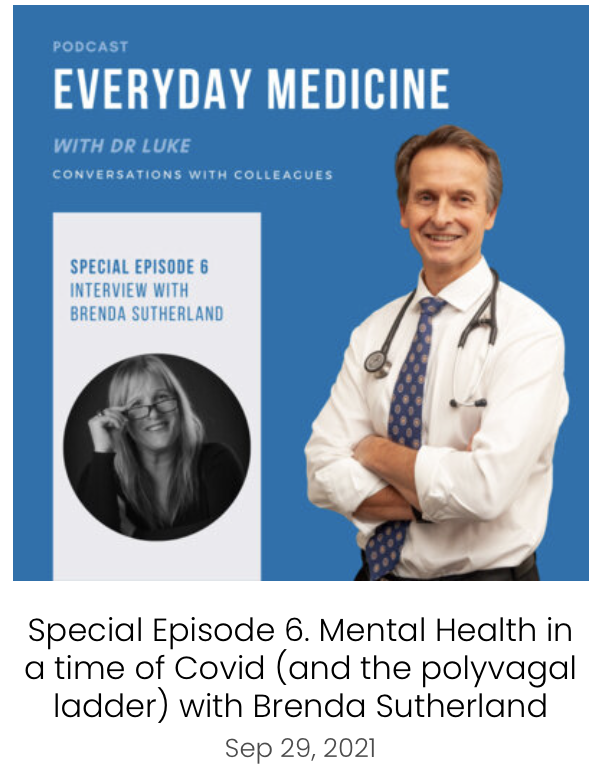
  • Mental Health in a time of Covid (and the Polyvagal Ladder) Podcast

    Mental Health in a time of Covid (and the Polyvagal Ladder) Podcast

    Mental health has become a major casualty of the Covid pandemic that has swept across the globe and been responsible for rolling lockdowns throughout Australia restricting personal freedoms, social contact and the ability to prosper financially. No one is exempt from this unprecedented event and the anxiety, depression and anguish wrought is having a major effect on the mental health and wellbeing of our communities.

    Dr Luke Crantock has a conversation with therapist, Brenda Sutherland founder and director of The Awakening Group to discuss the indicators that a patient or friend may be experiencing, the evolving mental health difficulties and learning methods for shifting patients holistically out of collapse.Brenda teaches us about the polyvagal ladder and how to use an understanding of this insight to instructively and empathically assist our most vulnerable patients.

    Brenda’s extensive knowledge of the human mental state in distress and happiness and her work with Bessel van de Kolk, Dr Stan Tatkin and Byron Katie have placed her in an outstanding position to guide us on this subject.

    Please enjoy the conversation.


    CLICK HERE TO LISTEN


    Dr Luke Crantock MBBS, FRACP, is a gastroenterologist in practice for over 25 years. He is the founder of The Centre for GI Health, based in Melbourne Australia and is passionate about educating General Practitioners and patients on disease prevention and how to manage and improve their digestive health.

    References:

    http://awakening.com.au/lms/2021/08/24/ventral-vibes-project/

    Mental health services in Australia, COVID-19 impact on mental health

    Weekend Australian – Aug 28-29 pages 1&6


  • Ventral Vibes Project

    Ventral Vibes Project

    Ventral Vibes Project

    Due to the enormous challenges and changes we are currently facing on a daily basis, our nervous system is overwhelmed, as we move from brain automation of daily tasks to refocusing on adjusting to new changes  in our everyday lives. One day we are free to go to work and get that coffee on the way, whilst saying chatting to people we see each morning to the next day we are in lockdown, and a sense of disconnection, disappointment and discombobulation. The constant changes and restrictions mean that our nervous system tries to find ways to adjust and survive, adaptions that are not always supportive.

    Stephen Porges’s ‘Polyvagal theory’ outlined survival states our autonomic nervous system moves within; Social Engagement (Ventral Vagal new vagus nerve: branch of the Parasympathetic vagus nerve), Sympathetic (fight/flight) and Dorsal Vagal (collapse/freeze/stuck on off). These states are all in service to our survival. It is essential that we befriend, listen to and understand our nervous system yet we often feel overwhelmed with what is happening within us, so much so we become stuck and difficult to move freely out of certain states. The majority of the time we are in resistance to our nervous system which creates an enormous about of inner turmoil.

    Deb Dana developed ‘The Polyvagal Ladder’ to help identify where we are in our nervous system response, what the experience is of being in that zone and understand how to move in and out of states. In other words we are educating our nervous system as to its responses, making friends with it so we don’t get stuck in particular states, and demonstrating how it can fluidly change emotional states. In this sense we become masters of our nervous systems rather than a slave.

    “The great thing then, in all education, is to make our nervous system our ally as opposed to our enemy.” William James (1914, Habit)


    A Little Science: The Autonomic Nervous System

    Simply the autonomic nervous system includes two branches:


    1. The Parasympathetic Branch The Vagus Nerve, the “wanderer” has two branches: Ventral Vagus (new vagus) and the Dorsal Vagus (old vagus).
      • This part of the nervous system travels from the brain stem at the base of the head, and travels down through the lungs, heart, diaphragm, and stomach and upward connecting with nerves in the neck, throat, eyes, and ears, to form the “face-heart” connection – “the compassion nerve”.
      • Ventral Vagal (new vagus) is a state of receptivity, social engagement, self and co-regulation, connected, in the flow and a sense of vitality. We feel safe, connected and alive is this state.
      • Dorsal Vagal (old vagus) is a Freeze response whereby we collapse, faint, or fawn death for survival. Often when a situation becomes too overwhelming to fight or flee we collapse. Animals freeze when captured to fain death from a predator to ensure they do not feel pain, and in many cases survive when the predator lets go, thinking their prey is dead. This state can be experienced in a number of ways including feeling numb, immobilised, helpless, lifeless, a sense of hopelessness, lack of motivation, depression, and giving up. We are stuck on off. This maybe a very familiar experience at the moment considering the overwhelming circumstances many people are experiencing.

    2. The Sympathetic Nervous System is mobilised in response to threat, involving the Fight or Flight responses, which could be further heightened for those who have a background of trauma in their lives.

    2019 DDP International Conference www.DDPNetwork.org

    ‘Engaging the Rhythm of Regulation A Polyvagal Theory Guide to Safety and Connection’ by Deb Dana, LCSW, DDP International Conference September 9, 2019  debdanalcsw.com, rhythmofregulation.com

    Scoping the Internal Landscape

    Firstly, Take a moment and think back to a time in your life when you felt the most happiest, alive, engaged, connected with others, life and yourself. Write down the feelings, sensations in your body you experienced when in this state. Give it a word that summarises this state for you.

    Furthermore when in this state (finish these statements):

    • I am ……
    • The world is……

    For example: flow, connected, warm, open-hearted, curious, engaged, capable, confident, organised, motivated, passionate, at ease.

    Key word: Flow

    I am…. safe

    The World is…welcoming, filled with possibilities

    This now becomes the top of the Polyvagal ladder and your ‘Ventral Vagal Anchor’ that you can come back to anytime you like.

    Secondly, the next step down the ladder is the Sympathetic Mobilised zone. Take a moment and think back to a time in your life when you felt frightened, anxious to the point your nervous system went into fight or flight. Repeat the above process, writing the sensations, feelings and body experiences and key word down. This becomes the second rung down on the polyvagal ladder.

    For example: out of control, raging, too much, confusing, discombobulated, overwhelming, angry, confrontational, ready to run

    Key word: Chaos

    I am crazy, dangerous, toxic

    The World is…scary, unfriendly, exploding


    Thirdly, go a step further down the ladder to the Dorsal Vagal Collapse. Again take a moment and think back to a time in your life when you experienced a sense of collapse, overwhelmed to the point of numb. This becomes the bottom rung down on the polyvagal ladder.

    For example: dark foggy, stuck, silent, disorganised, out of focus, cold, numb, hopeless, helpless, shut down, disconnected.

    Key word: Darkness

    I am unloveable, invisible, lost and alone

    The World is…cold, empty and uninhabitable.


    Fourthly, take each state from above and draw an art piece. Deb Dana coined it ‘The Art Map’. This assists in cementing a somatic awareness of the states and creates the ability to be engaged with a state not engaged by a state.


    art map polyvagal

    Art Map By David Keevil from https://www.youtube.com/watch?v=M-SVdQ-CHkA


    The Four R’s:

    Here’s a few steps to help.

    • Recognize the autonomic state,
    • Respect the adaptive survival response,
    • Regulate/co-regulate into a Ventral Vagal state
    • Re-story.

    When you find yourself experiencing challenging situations:

    1. Notice where you are on the Polyvagal ladder; Ventral Zone, Fight/Flight or Dorsal Vagal Collapse.
    2. Name it
    3. Befriend the state, by turning towards it – Claim it
    4. Bring curiosity
    5. Listen for a moment to the story from the Ventral Zone, of the state – Tame it


    Moving Into The Ventral Zone

    “Earth will be safe when we feel in us enough safety.” Thich Nhat Hanh

    It is not that we are continually in the ventral zone, as there are times where we will move into the other states. It is the ability to easily move back into the ventral zone. In developing our own autonomic intimacy we need a repertoire of activities, games, exercises, somatic experiences, and visual and auditory aids to utilise to assist returning in the ventral vibes zone in challenging times.

    Activation of the ventral vagus nerve is associated with:

    • feelings of care taking
    • ethical intuition that humans from different social groups (even adversarial ones) share a common humanity
    • feeling emotions that promote altruism – compassion, gratitude, love, and happiness

    What are some activities that bring you back to the Ventral Vibes Zone? Write them down. Find activities that work for you…and if you like, add to the below list.

    • dancing or movement ie hip hop,
    • music making together, collaborative art making that sync our nervous systems
    • play and imagine, dress ups, game making
    • team sports that bring us into resonance with others,
    • connection with nature,
    • eye gazing, sex/lovemaking, connecting with others helping a friend. Co-regulating games using eyes, ears/sounds, voice, and facial movements. We are wired to connect!
    • breathing exercises ie Pranayama breathing
    • touch using Betty Martin’s 3 minute game, proximity seeking exercises,
    • vocal bursts..ahhhhh, ohhhhh, hmmmm etc
    • Develop a gratitude diary

    Benefits of Autonomic Flexibility

    We are continually reshaping the autonomic nervous system and the above exercises will help. By mastering staying in the Ventral Vagal Zone we

    • Reduced inflammation and regulation of pro-inflammatory cytokines
    • Control our immune response
    • Able to Emotionally regulate our own nervous systems and others around us
    • Ability to inhibit distractions
    • Develop stress resilience

    “Reshaping practices remind the autonomic nervous system that it has an inherent knowing about how to flexibly navigate the autonomic hierarchy”. Deb Dana

    Putting it to the Test

    Now that you have mapped out your own personal Polyvagal ladder, drawn an Art Map, and selected exercises, games, connection activities that help you move freely into the Ventral Vagal state lets put it to the test. Go back to the situation you remembered that caused collapse or the Fight/Flight response and use the somatic awareness when drawing and bringing awareness to each state to move out of that state by Naming it, Claiming it through befriending it, and Taming it, that is moving back into Ventral Vagal.

    How did you go? Are there any adjustments needed? Now try another state and repeat the process.

    This is your autonomic intimacy at work and can be engaged in anytime in distress, stuck on off, or your nervous system is mobilised.

    You’ve got this!

    Please share your Ventral Vibes below.


    ___________________________________________________

    Bibliography

    Armitage, Hanae, ‘Sound research: Scientific Innovation harness noise and acoustics for healing’. Stanford University.

    Dana, Deb, Engaging the Rhythm of Regulation A Polyvagal Theory Guide to Safety and Connection, (September 9, 2019) DDP International Conference

    Hip Hop Therapy Studio (June 29, 2021) Trauma Research Foundation


  • The ‘F’ Word

    The ‘F’ Word

    Feelings! We don’t like to think about them, feel them, acknowledge them, and yet they remain, and at times completely take over our experience of ourself.

    Some people go so far as to completely try to avoid them, resulting in high anxiety. Some default to anger in the hope of gaining some sense of safety from other distressing feelings. Some leave their bodies to ensure nothing is felt. Some people drink, take drugs to escape them. Yet the fact remains – we all have feelings!


    What are Feelings?

    Dr. Bryn Farnsworth describes feelings as the conscious experience of emotional reactions. While emotions are associated with bodily reactions that are activated through neurotransmitters and hormones released by the brain. Paul C Holinger M.D. outlines a range of definitions trying to capitulate the complexities of emotions including: Sensorimotor reflexive, Sensorimotor enactive, Preoperational, Concrete operational and Formal operational.

    Much research has compared feelings with emotions and their differences, depending on emotional and cognitive development.

    If you are not a neuroscientist or neuropsychologist and you are just wanting a quick definition, the bottomline is they are ‘electrical energy’ in the body. How they move, or get stuck in the body is the key to being a slave to them or being a master of them.

    Mastering Feelings

    What to do with feelings is the real mastery!

    Firstly, the mind works vigilantly looking outwards for a way to get rid of these feelings, resulting in feelings being resisted, which in turn locks them in the body as energy, pain and anguish. We try to change our environment, the people around us, our mind etc, yet feelings remain. Literally what we resist persists!  Turning the mind inwards means there is no resistance to the feelings.


    Try This For A Minute

    Instead of turning your mind outwards to change people or places turn your mind inwards and surrender to the feeling. Now the trick is, you cannot ‘do’ surrender with the mind. This is definitely not the realm of the mind. The step the mind can do is simply turn inwards. Then for a moment let go into the feeling with your whole being. Stop and Drop into it. Surrender. Not with any particular outcome in mind, other than to let the feeling have you. No resistance. For one moment don’t pick up anything or move away from the feeling, let it overtake you. tricky for the mind as it thinks it will die at times. What happens then?

    No resistance to energy means the energy simply flows through you. The ultimate alchemy of the soul! At times anxious can be transmuted into bliss simply by surrendering.

    I know it sounds easy, but the mind always makes things more difficult. So without the story the mind tells you, simply directly experience the feeling….What happens?


    Bibliography

    Farnsworth, Bryn PhD., April 2020. How to Measure Emotions and Feelings (And the Difference Between Them)  https://imotions.com/blog/difference-feelings-emotions/

    Holinger, Paul C., M.D. March 2016, What Are Feelings? How are they related to drives or instincts? https://www.psychologytoday.com/au/blog/great-kids-great-parents/201603/what-are-feelings